44 Comments

Ten Major Symptoms of Spiritual Abuse

Ten Symptoms of Spiritual Abuse

Sheep and Wolves, via Pinterest.

What is spiritual abuse?

I once linked to an excellent article by Mary DeMuth which talks about 10 Signs of Spiritual Abuse. But I have received enough emails and questions to warrant another, separate post covering other symptoms of spiritual abuse.

Jeff VanVonderen, co-author of the classic book The Subtle Power of Spiritual Abuse, defines spiritual abuse like this:

“Spiritual abuse occurs when someone in a position of spiritual authority–the purpose of which is to ‘come underneath’ and serve, build, equip and make God’s people more free–misuses that authority by placing themselves over God’s people to control, coerce or manipulate them for seemingly godly purposes which are really their own.”

VanVonderen adds:

“Nothing about spiritual abuse is simple. Those who have experienced it know it is powerful enough to cause them to question their relationship with God, indeed, the very existence of God. And it is subtle too! The perpetrators of spiritual abuse are rarely ‘Snidely Whiplash’ sorts of characters who announce that they are going to drain your spiritual energy. They may be people who seem like they are seeking to guide you to the deepest levels of spiritual maturity.”

Biblical evidence: While the term “spiritual abuse” does not occur in the Bible (nor does the word “Trinity,” for that matter), the concept is clearly alluded to. Primary biblical citations which discuss spiritual abuse include Ezekiel 34:1-10; Matthew 20:25; 23:1-33; Luke 22:24-27; and 1 Peter 5:3. Each of these passages involves God condemning leaders who mistreat the people under their care in order to promote their own welfare or ideology.

Ten Major Symptoms of Spiritual Abuse:

1.) Salvation Redefined – Spiritually abusive ministries continually redefine salvation. This keeps the bar moving higher and higher so that followers must stay dependent on the Ten Symptoms of Spiritual Abuseintercession, wisdom, and power of the leader. Healthy leaders, on the other hand, communicate a clear biblical gospel of salvation by grace through faith. God’s plan of salvation never changes.

2.) Deification of Leaders – While few spiritually abusive leaders overtly claim divinity, in practice they act as if they are godlike. For example, the leader may say that he or she speaks for God, that God works exclusively through his or her ministry, or that followers can please God by pleasing the leader. Healthy leaders, however, avoid putting themselves in the place of God.

3.) Exhaustion – Spiritually abusive ministries exhaust their followers through high commitment and endless demands on time and service. If you always feel exhausted after church—or if your church life seems one continuous demand on your time with never a chance to rest—you may live in a spiritually abusive system. Healthy churches and leaders understand the need for rest and personal time. After all, even God rested on the seventh day.

4.) “Sacrificial” Giving – Spiritually abusive ministries regularly call for sacrificial giving of time, talents, and treasure. The Bible knows little of this. Instead, the New Testament calls for generous and cheerful giving (2 Cor 8 and 9). While God does sometimes call us to give sacrificially, this is between us and the Holy Spirit. For example, the Philippians gave sacrificially and amazed even the Apostle Paul. But no person can demand such sacrifice, and certainly not on an ongoing basis. Healthy churches teach biblical giving which is based on generosity and freewill, not coercion or guilt.

5.) Transactional Giving – Spiritually abusive ministries correlate the giving of your time and money with physical or spiritual blessing. The more you give—or the more dedicated you are to the ministry—the more blessed you will be. This is a works-based system of salvation and sanctification. Healthy ministries focus on transformational giving which is simply a byproduct of thankfulness and faith.

6.) Abuse of Special Revelation – Spiritually abusive leaders often claim to have special insight into the will of God for you and your family. Rather than sharing such “special” revelation and giving you freedom to decide whether the Spirit spoke it or not, Spiritual Abuse and Special Revelationsuch leaders demand that you obey their pronouncements. Healthy leaders, on the other hand, may also sometimes receive special revelation from the Spirit, but they communicate such “words” from the Lord with humility, qualification, and room for doubt. They allow you to respond—and even disagree—rather than forcing you to obey. And such “words” never benefit the leader financially or in regard to gaining power over you.

7.) Perfectionism – Spiritually abusive ministries may have a mentality which demands full sanctification from members in order to prove that they are saved. This may masquerade as a focus on bearing spiritual fruit, becoming mature in the faith, or living sanctified lives. In reality, such leaders want to control the people underneath them, and the easiest way to do this is to point out their sins (or supposed sins) and show how worthless and hopeless they are. This keeps people dependent on the intercession and teaching of the leader. Healthy leaders, on the other hand, recognize the role of grace in salvation and understand that all believers are sinners in need of mercy, patience, and understanding. We all wear checkered garments on the way to glory.

8.) Shaming – Spiritually abusive ministries often publicly shame their followers. Leaders in such groups misuse confidential information and share it widely in order to humiliate people. Or they bad-mouth people who have left the group. This maintains an atmosphere of fear, degradation, and disempowerment. Healthy leaders, however, maintain confidences, encourage the weak, and empower people under their care toward maturity and joy in Christ.

9.) Exclusivity – Spiritually abusive ministries denigrate other Christian leaders or churches. They claim that they alone have the truth, that they alone practice biblical Christianity, or that they alone have access to God’s will and pleasure. Whether this is Exclusivity of Spiritually Abusive Churchesstated explicitly or remains implicit, followers understand that to leave the group is to fall out of grace or to become a friend of the world. Conversely, healthy leaders rejoice that God is working all over the world. They try to see the best in other groups and Christian leaders, even when they must sometimes speak words of discernment or correction about them. Followers are empowered to understand that the Holy Spirit works variously in other situations and cultures and that he doesn’t make clones.

10.) Punishment – Spiritually abusive groups use church discipline passages as an excuse to punish current members or to shun ex-members. They use church discipline to keep people in line, to quell disagreement (which they call “rebellion”), and as a threat against critical thinking (which they call “pride”). They also overreact to small sins or minor behavioral issues and bring the full weight of church discipline against people who actually just need time to mature. Leaders of these groups misunderstand the purpose of church discipline, which is restorative, not punitive. Spiritually abusive groups also misinterpret the warning passages in the book of Hebrews—they claim that people who leave their select group have left the faith. In contrast, healthy leaders use church discipline only in serious matters of major unrepentant sin. And they understand that the goal of such corrective measures is restoration, not punishment.

Conclusion:

If you read this checklist and discover that it applies to your church or group, you likely live in a spiritually abusive system. God has better things for you. Consider what steps you might take to disengage from the abusive group and plug into a healthy system full of grace and truth.


Leave a comment

Unspeakable Hurt: Dysfunctional Families and Recovering from Abuse

Rarely do I write a post which consists primarily of a link.

This is such a post.

My wife and I listened today to a talk by Lorie Kaufman-Rees. She is the Support and Recovery Pastor at Vineyard Columbus, and a licensed counselor.

Dysfunctional FamiliesRees spoke about abuse issues in families, using the Old Testament story of Amnon and Tamar in 2 Samuel 13. In her talk, she explains the five dynamics of families who wound, and the three ways that Jesus can heal those wounds.

While much of Rees’s message relates to sexual abuse within families, the principles are transferable to any type of abuse: physical, sexual, spiritual, or emotional.

I have found in my own experience that leaders who disrespect spiritual boundaries often crash with impunity through other boundaries. There is a high correlation between spiritual abuse and sexual abuse.

Rees’s talk lasts 44-minutes. It is well worth your time. I was not the only one who had to dab my eyes after it finished. If you are a victim of spiritual or sexual abuse, this message will speak to you.

Here’s the link: http://www.vineyardcolumbus.org/watch-listen/messages/unspeakable-hurt/

Note: If you listen to this message and find that it brings up a whole host of issues, please refer to my “Resources” page for links to licensed Christian counselors. Or contact the good people at Hope for the Heart here. And always remember: You can’t heal what you can’t feel.

8 Comments

Is it a Sin to Seek Medical Help?

A Pennsylvania couple was jailed after another of their children died from lack of medical treatment.

Faith Healing Child Dies

Herbert and Catherine Schaible

Herbert and Catherine Schaible were jailed after their 8-month-old son, Brandon, died from diarrhea and breathing problems. The Schaibels refused to seek medical treatment for their son. Another son died in 2009 after contracting pneumonia–again without receiving medical intervention. The Schaibles were convicted of involuntary manslaughter in that case and placed on ten years probation. See full USA Today article here.

The Schaibles belong to the First Century Gospel Church near Philadelphia. Members of this church are taught to believe that it is a sin to seek medical treatment. A sermon from the church said: “It is a definite sin to trust in medical help and pills; and it is real faith to trust on the Name of Jesus for healing.”

That is a bald-faced lie.

It simply isn’t true. And it is spiritually abusive. Yet folks continue to believe such distorted teaching. I have written more extensively about faith healing here.

In short, what these groups believe is a simplistic misinterpretation of scripture. While the Bible does talk about praying for healing (James 5:13-16), it never says that every prayer for healing will be answered, nor that great faith will guarantee healing, nor that medical treatment is sin. Indeed, one of the Gospel writers was a physician (Luke), and the Apostle Paul prescribed medical treatment for Timothy.

Let’s continue to educate ourselves and others about what the Bible actually says about faith healing: trust in God, yes, but also see a doctor. Maybe the miracle you’re asking for is disguised within modern medicine.

Update, 2/20/14: The Schaibles were just convicted of third-degree murder and sentenced to prison time and probation. “Philadelphia Common Pleas Judge Benjamin Lerner told the couple that it was not their son’s time to die. ‘You killed two of your children … not God, not your church, not your religious devotion — you,’ the AP reported.” Here’s the link to the HuffPost article.

Related posts:

The Death of Faith
Faith Healing? Trust in God, but See a Doctor
Wisconsin Faith-Healing Case May Set Precedent

4 Comments

Friendly Riots and Sweet Baby Jesus: The Dangers of Antinomianism

I’ve seen only one riot first-hand. But it was a friendly riot. A Christian riot. So it was okay, right?

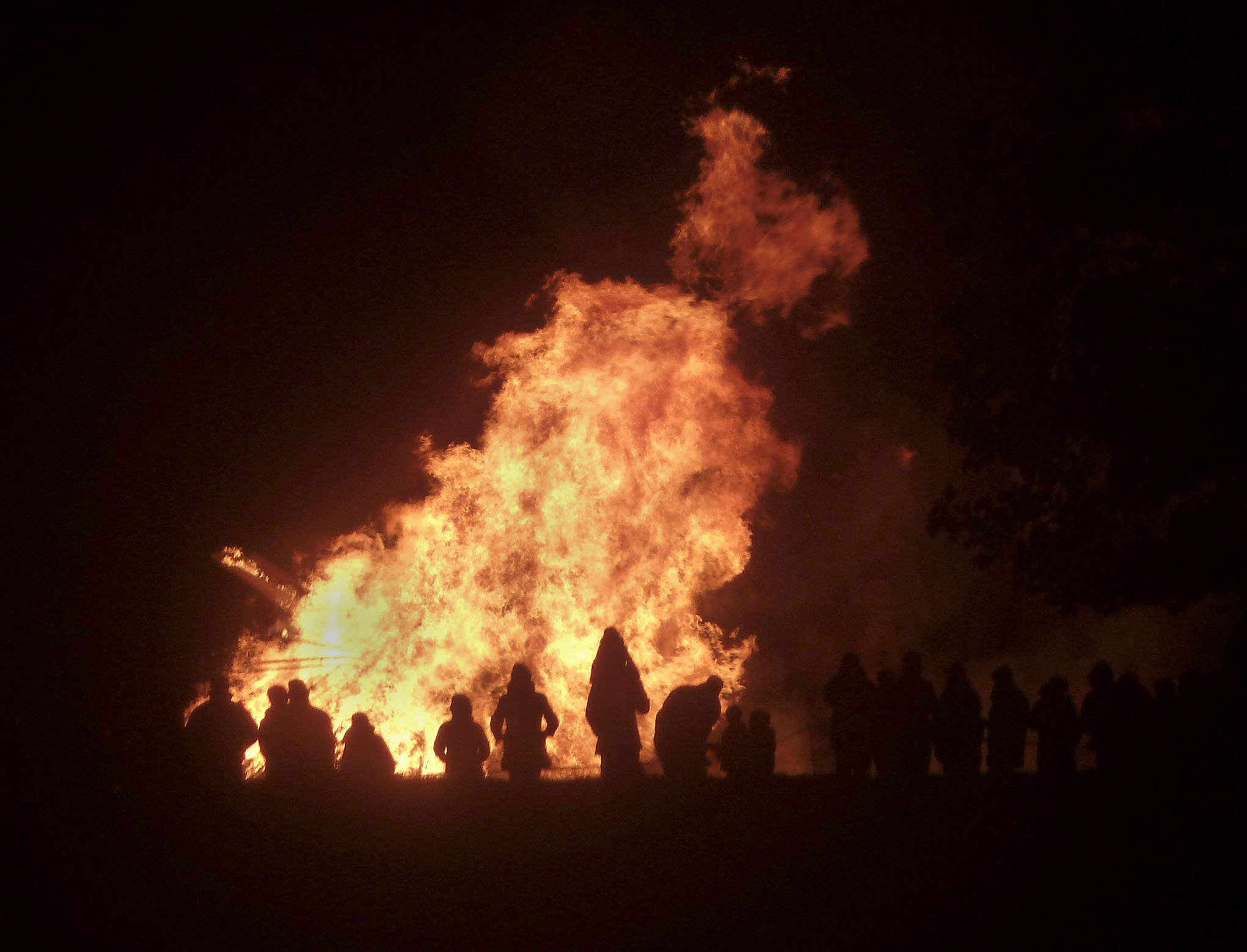
Christian-AntinomianismIt wasn’t the naked young men streaking through campus who most disappointed me. It wasn’t the destruction and theft of property, the illegal bonfire blazing in the middle of campus, or the smoke bombs detonated in the girls’ dorms.

What most bothered me about the friendly riot at my Christian college was its effect. Campus police called for back-up and heard the static of law enforcement scanners from neighboring Indiana towns: “Let’s go arrest those Christian hypocrites.”

Here’s the context.

A scheduled campus-wide power outage at 1am early in December 2004 turned into a hedonistic free-for-all. An all-campus email distributed by school officials alerted students to the impending blackout. Streetlights would blink off. Emergency lights would flick on in dorms. Students should plan for the outage.

And they did—with military precision.

As soon as the lights shut off, young men from one of the large dorms lit a bonfire in the middle of campus. Students flocked to it like moths to a flame. So did campus police. With the cruisers thus occupied, another commando group used bolt cutters to crack the chains which stapled life-sized Nativity figures to the ground. The next morning, campus police spotted one of the wise men and his camel placidly adjusting to life atop the Dining Commons.

Streakers sprinted through dorms, smoke poured from the hallways of a girls’ residence hall. Muddy butt-cheek marks lined the floor-to-ceiling glass of a certain campus building.

Christian Antinomianism-Friendly-RiotAs I sat in my dorm room watching “Band of Brothers” on my laptop with a couple of friends, I heard outside the shrieks of hundreds of frolicking students and the throbbing wail of police sirens lacerating corn-stubbled fields. For two Antinomian hours, the students at my Christian university lived without laws.

And the saddest thing?

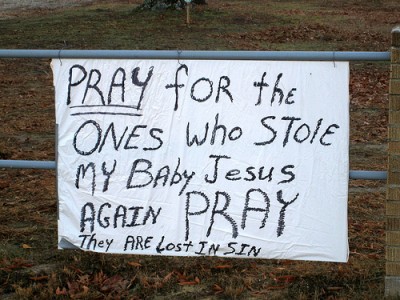
They kidnapped sweet Baby Jesus.

It doesn’t take a friendly riot (a riot in which no one is injured) to show that some believers embrace a questionable amount of license as they walk a path of grace from earth to heaven.

Antinomianism is a problem in many Christian circles.

What is Antinomianism?

In short, it means lawlessness. In fact the word comes from two Greek words, “anti” which means “against,” and “nomos” which means “law.” So Antinomians are against laws or constraints–to a greater or lesser degree.

In Christian circles, we describe this as “license,” which is to say that some folks believe that because they have been saved by grace, they can sin all they want. Conduct no longer matters because they only need to have faith. Few Antinomians are this blatant in their expression, but taken to its extreme, Antinomianism results in sinful living which displeases God and harms other people.

Why It’s Bad

A.W. Tozer defined the dangers of Antinomianism this way (hold onto Baby Jesus):

Fundamental Christianity in our times is deeply influenced by that ancient enemy of righteousness, Antinomianism. The creed of the Antinomian is easily stated: We are saved by faith alone; works have no place in salvation; conduct is works, and is therefore of no importance. What we do cannot matter as long as we believe rightly. The divorce between creed and conduct is absolute and final. The question of sin is settled by the Cross; conduct is outside the circle of faith and cannot come between the believer and God.

Such in brief, is the teaching of the Antinomian. And so fully has it permeated the Fundamental element in modern Christianity that it is accepted by the religious masses as the very truth of God.  Antinomianism is the doctrine of grace carried by uncorrected logic to the point of absurdity. It takes the teaching of justification by faith and twists it into deformity.

Christians who practice Antinomianism believe that because Jesus fulfilled the Old Testament Law when he died on the cross (Romans 10:4; Galatians 3:23-25; Ephesians 2:15), there are no longer any moral laws that Christians have to obey.

What the Bible Says About It

I like how S. Michael Houdmann describes Antinomianism:

“The apostle Paul dealt with the issue of Antinomianism in Romans 6:1-2, ‘What shall we say, then? Shall we go on sinning so that grace may increase? By no means! We died to sin; how can we live in it any longer?’ The most frequent attack on the doctrine of salvation by grace alone is that it encourages sin. People may wonder, ‘If I am saved by grace and all my sins are forgiven, why not sin all I want?’

Christian Antinomianism“That thinking is not the result of true conversion because true conversion yields a greater desire to obey, not a lesser one. God’s desire—and our desire when we are regenerated by His Spirit—is that we strive not to sin. Out of gratitude for His grace and forgiveness, we want to please Him. God has given us His infinitely gracious gift in salvation through Jesus (John 3:16; Romans 5:8). Our response is to consecrate our lives to Him out of love, worship, and gratitude for what He has done for us (Romans 12:1-2). Antinomianism is unbiblical in that it misapplies the meaning of God’s gracious favor.

“A second reason that Antinomianism is unbiblical is that there is a moral law God expects us to obey. First John 5:3 tells us, ‘This is love for God: to obey His commands. And His commands are not burdensome.’ What is this law God expects us to obey? It is the law of Christ – ‘Love the Lord your God with all your heart and with all your soul and with all your mind. This is the first and greatest commandment. And the second is like it: Love your neighbor as yourself. All the Law and the Prophets hang on these two commandments’ (Matthew 22:37-40).

“No, we are not under the Old Testament Law. Yes, we are under the law of Christ. The law of Christ is not an extensive list of legal codes. It is a law of love. If we love God with all our heart, soul, mind, and strength, we will do nothing to displease Him. If we love our neighbors as ourselves, we will do nothing to harm them. Obeying the law of Christ is not a requirement to earn or maintain salvation. The law of Christ is what God expects of a Christian.

Antinomianism when the lights go out“Antinomianism is contrary to everything the Bible teaches. God expects us to live a life of morality, integrity, and love. Jesus Christ freed us from the burdensome commands of the Old Testament Law, but that is not a license to sin, but rather a covenant of grace. We are to strive to overcome sin and cultivate righteousness, depending on the Holy Spirit to help us.

“The fact that we are graciously freed from the demands of the Old Testament Law should result in our living our lives in obedience to the law of Christ. First John 2:3-6 declares, ‘We know that we have come to know Him if we obey His commands. The man who says, “I know Him,” but does not do what He commands is a liar, and the truth is not in him. But if anyone obeys His word, God’s love is truly made complete in him. This is how we know we are in Him: Whoever claims to live in Him must walk as Jesus did.’”

From http://www.gotquestions.org/antinomianism.html

Conclusion: Striking a Balance

We can place Antinomianism on a spectrum of belief like this:

License—-Liberty—–Legalism

Christian Antinomianism LawlessnessCan you see that both License (Antinomianism) and Legalism take an extreme view of Christian living, while Liberty takes the moderating position? That’s why this blog is called “Liberty for Captives”—we want to strike a balance.

Probably your church doesn’t hold too many friendly riots. But many churches emphasize the biblical teaching of grace to such an extent that they lose sight of the New Testament truth that we evidence our love for God by obeying his commands (1 John 2:3-6).

Yes, we are saved by grace, but grace never provides an excuse to sin.

Not even when the lights go out.

3 Comments

The Terror of “Normal”: Religious Brainwashing and the Boston Bombers

Perhaps you, like I, feel relief after the death of one Marathon bombing suspect and the capture of the second. But perhaps you also feel something else. Something besides relief, anger, or pain.

Something like confusion.

Religious Brainwashing and the Tsarnaev BrothersAfter all, why would two young men described by acquaintances as “friendly,” “soft-spoken,” “popular,” and “safe” suddenly commit major terrorist acts?

The shock factor stems not just from the magnitude and visibility of what happened, but because it seemed to come from nowhere.

Americans have grown to understand—with distaste—that mentally ill and socially isolated people can commit terrible crimes. Think Adam Lanza and Newtown, or James Holmes and the Aurora movie theater massacre. We look at their mug shots and say, “Gosh, sure, I can see that. The fellow just looks off. He has dyed-red hair. A sightless stare. Thin-lipped angst. *cluck* I could have seen it coming.”

We also can understand how foreign-trained fighters could fly planes into buildings. We hate it, but we put those types of people in a different category from us. Their zealotry makes a sick sort of sense.

Religious Brainwashing and the Tsarnaev Brothers

Dzhokhar and Tamerlan Tsarnaev

But with Dzhokhar and Tamerlan Tsarnaev, we see something uncomfortably different.

We see normalcy.

And it terrifies us. Because if these “normal” fellows committed a crime like this, who else may be lurking in the shadows of normal, waiting to become tomorrow’s front-page terror story?

If “normal” can kill with such callous disregard for innocent life, then we’re in a whole world of hurt.

But I believe there’s a likely explanation as to why these “normal” young men committed such an abnormally cruel and despicable crime. The strongest causative explanation?

Religious brainwashing.

Religious Brainwashing and the Tsarnaev Brothers

In a Today Show interview, Ruslan Tsarni, the uncle of Dzhokhar and Tamerlan Tsarnaev, said he noticed a difference in Tamerlan when he saw him in 2009. The previously soft-spoken, polite young man seemed more radical, as if he had been influenced by religious extremists. “I was shocked when I heard his words, his phrases, when every other word he starts sticking in words of God,” said Ruslan. “I question what he’s doing for work, (and) he claimed he would just put everything in the will of God. It was a big concern to me.”

Religious Brainwashing and Tamerlan TsarnaevThe boys grew up in Ruslan’s home after immigrating to the United States, but seemed to have fallen under the influence of mentors who radicalized them. Ruslan said an acquaintance expressed similar concerns: “He said there is someone who brainwashed [Tamerlan], some new convert to Islam.”

Tamerlan’s change of personality was so noticeable, his uncle believed he was being converted to an extreme form of Islam. “It wasn’t devotion,” Ruslan said, “it was something, as it’s called, being radicalized. Not understanding what he is talking (about). He is just using words for the sake of the words and not understanding the meaning of it.’’

In a recent story, The Guardian newspaper said, “Since his death, it has been revealed that a YouTube account believed to be managed by Tamerlan linked to online material concerning radical preachers, terrorism and a religious prophecy supposedly popular with al-Qaida followers.”

It remains to be seen exactly how this radicalizing influence may have played out in the lives of Tamerlan and his younger brother, Dzhokhar. But their uncle, for one, believes that Tamerlan was brainwashed by religious extremists and in turn influenced his younger brother Dzhokhar to help commit unspeakable crimes. It would not surprise me to learn that Dzhokhar—if he survives his injuries—eventually snaps out of his altered state of mind and becomes truly penitent for what he has done.

A Brief History of Religious Brainwashing

It is well-known that certain religious extremist organizations use brainwashing techniques on their followers to promote mindless devotion (whether they know that this is what they’re doing is much more debatable). For example, in his book Taliban, Ahmed Rashid reports the brainwashing of young Taliban recruits in Pakistani madrassas. The young boys sit for hours reciting verses from the Koran as they rock back and forth. They listen to sermons by influential imams and all outside information is strictly controlled and interpreted.

Religious Brainwashing

David Koresh

Similarly, certain Christian cults also brainwash their followers. Jim Jones led his People’s Temple followers to their murder/suicide deaths in Guyana in 1978. Branch Davidian leader David Koresh brainwashed his followers into a radical separatism and anti-government posture which contributed to the famous standoff in Waco, Texas in 1993.

Such techniques can turn an affable, sweet person into a programmed machine. While appearing “normal” from outward appearances, such a brainwashed person is susceptible to trigger words, extreme devotion to radical ideas, and dehumanization of other people.

ABCs of Brainwashing: Dr. Robert Lifton’s Eight Criteria for Thought Reform

How does brainwashing work?

Dr. Robert Lifton is considered an expert in the field. After studying both political and religious brainwashing, he identified Eight Criteria for Thought Reform:

1.) Milieu Control. This involves the control of information and communication both within the environment and, ultimately, within the individual, resulting in a significant degree of isolation from society at large.

2. Mystical Manipulation. There is manipulation of experiences that appear spontaneous but in fact were planned and orchestrated by the group or its leaders in order to demonstrate divine authority or spiritual advancement or some special gift or talent that will then allow the leader to reinterpret events, scripture, and experiences as he or she wishes.

3. Demand for Purity. The world is viewed as black and white and the members are constantly exhorted to conform to the ideology of the group and strive for perfection. The induction of guilt and/or shame is a powerful control device used here.

4. Confession. Sins, as defined by the group, are to be confessed either to a personal monitor or publicly to the group. There is no confidentiality; members’ “sins,” “attitudes,” and “faults” are discussed and exploited by the leaders.

Religious Brainwashing and the Tsarnaev Brothers

Dzhokhar Tsarnaev. Was he influenced by any of these brainwashing criteria? Time will tell.

5. Sacred Science. The group’s doctrine or ideology is considered to be the ultimate Truth, beyond all questioning or dispute. Truth is not to be found outside the group. The leader, as the spokesperson for God or for all humanity, is likewise above criticism.

6. Loading the Language. The group interprets or uses words and phrases in new ways so that often the outside world does not understand. This jargon consists of thought-terminating clichés which serve to alter members’ thought processes to conform to the group’s way of thinking.

7. Doctrine over Person. Member’s personal experiences are subordinated to the sacred science and any contrary experiences must b e denied or reinterpreted to fit the ideology of the group.

8. Dispensing of Existence. The group has the prerogative to decide who has the right to exist and who does not. This is usually not literal but means that those in the outside world are not saved, unenlightened, unconscious and they must be converted to the group’s ideology. If they do not join the group or are critical of the group, then they must be rejected by the members. Thus, the outside world loses all credibility. In conjunction, should any member leave the group, he or she must be rejected also. (Lifton, 1989)

As you can see, the final criteria helps us understand how a “normal” person could commit a terrorist act. After all, if people who don’t believe what you believe are sub-human, it doesn’t matter too much if you kill them. Yikes.

Conclusion

It remains to be seen to what extent Dzhokhar and Tamerlan Tsarnaev were brainwashed. But based off of their uncle’s statements—and considering the descriptions of their friends—it seems likely that religious brainwashing played at least a part in their extreme actions.

Whether or not they were brainwashed, they are ultimately responsible for their own choices and will be held accountable. Brainwashing is never an excuse—only an explanation.

And in this case it may help to explain how “normal” young men could commit the Boston Marathon bombings.

Update, 4/25/13: The parents of Tamerlan and Dzhokhar, while grieving, have expressed their doubts about their sons’ involvement in the Boston Marathon Bombing, saying that they have been framed, that investigators have lied, that “America took my kids away.” See this NBC news link for details. While any parent could be expected to experience shock, disbelief, grief and confusion in similar circumstances, such statements seem to evidence a high degree of denial, blame-shifting, and unwarranted hostility. Not sure how this all relates to the brothers’ own ideological extremism, but it seems an unhappy correlation of radically detached thinking.

5 Comments

Pastoral Bullies: How to Tell if a Pastor “Domineers”

This post originally appeared April 17, 2013 on the “Enjoying God” blog by Pastor Sam Storms. Pastor Storms is a fellow Dallas Seminary grad, taught at Wheaton College, and currently is the Lead Pastor for Preaching and Vision at Bridgeway Church in Oklahoma City, Oklahoma. I find this post the clearest treatment of pastoral domineering that I have read. Check out the original post here. Pastor Storms is unlikely to remember, but I met him once at Wheaton College at my sister’s graduation. I am glad that my friend Lisa Robinson over at Theo Thoughts made me aware of this post. 

Lording it over the flock

Sam Storms

In his instructions to Elders/Pastors, Peter insists that they must not lead for love of power, which is to say they must not “domineer” those in their charge but rather be “examples” to them (v. 3b).

How might a pastor or elder “domineer” his flock? In other words, what makes a man a pastoral bully? Here are some ways.

A man can “domineer” or “lord it over” his flock by intimidating them into doing what he wants done by holding over their heads the prospect of loss of stature and position in the church.

A pastor domineers whenever he threatens them with stern warnings of the discipline and judgment of God, even though there is no biblical basis for doing so.

A pastor domineers whenever he threatens them with public exposure of their sin should they not conform to his will and knuckle under to his plans.

A pastor domineers whenever he uses the sheer force of his personality to overwhelm others and coerce their submission.

A pastor domineers whenever he uses slick verbiage or eloquence to humiliate people into feeling ignorant or less competent than they really are.

A pastor domineers whenever he presents himself as super-spiritual (his views came about only as the result of extensive prayer and fasting and seeking God. How could anyone then possibly disagree with him?).

Pastoral Abuse

Simeon Stylites lived atop a pillar for 37 years near Aleppo to become more “holy.”

A pastor domineers whenever he exploits the natural tendency people have to elevate their spiritual leaders above the average Christian. That is to say, many Christians mistakenly think that a pastor is closer to God and more in tune with the divine will. The pastor often takes advantage of this false belief to expand his power and influence.

A pastor domineers whenever he gains a following and support against all dissenters by guaranteeing those who stand with him that they will gain from it, either by being brought into his inner circle or by some form of promotion.

A pastor domineers by widening the alleged gap between “clergy” and “laity.” In other words, he reinforces in them the false belief that he has a degree of access to God which they don’t.

Related to the former is the way some pastors will make it appear that they hold sway or power over the extent to which average lay people can experience God’s grace. He presents himself in subtle (not overt) ways as the mediator between the grace of God and the average believer. In this way he can secure their loyalty for his agenda.

He domineers by building into people a greater loyalty to himself than to God. Or he makes it appear that not to support him is to work at cross purposes with God.

He domineers by teaching that he has a gift that enables him to understand Scripture in a way they cannot. They are led to believe they cannot trust their own interpretive conclusions and must yield at all times to his.

He domineers by short circuiting due process, by shutting down dialogue and discussion prematurely, by not giving all concerned an opportunity to voice their opinion.

He domineers by establishing an inviolable barrier between himself and the sheep. He either surrounds himself with staff who insulate him from contact with the people or withdraws from the daily affairs of the church in such a way that he is unavailable and unreachable.

Related to the above is the practice of some in creating a governmental structure in which the senior pastor is accountable to no one, or if he is accountable it is only to a small group of very close friends and fellow elders who stand to profit personally from his tenure as pastor.

He domineers by viewing the people as simply a means to the achieving of his own personal ends. Ministry is reduced to exploitation. The people exist to “serve his vision” rather than he and all the people together existing to serve the vision of the entire church.

He domineers by making people feel unsafe and insecure should they desire to voice an objection to his proposals and policies.

He domineers by convincing them, ever so subtly, that their spiritual welfare is dependent on his will. To cross him is to cross God!

He domineers by misinterpreting and misapplying to himself the OT command: “Don’t touch God’s anointed.”

He domineers by building a culture of legalism rather than one of grace. People are thus motivated to embrace his authority and bow to his will based on extra biblical rules that supposedly are the criteria for true spirituality.

He domineers by arguing or acting as if his movements and decisions are ultimately determinative of the spiritual welfare of others (cf. 2 Cor. 1:23-25).

He domineers when he leads people to believe that their faith hinges (i.e., rises or falls) upon his life and decisions.

He domineers when he uses people as a means to his own satisfaction rather than enabling them to experience satisfaction in Christ alone.

3 Comments

Hope for those Hurt by Spiritual Abuse

“The heavens declare the glory of God.” – Psalm 19:1

A child will handle incredible amounts of pain if only he has hope.

It may come through a single soft word, a fleeting kindness, or the frailest wisp of a verse unthreaded from scripture’s thick mat.

Even for those who, like me, were caught for years in the sticky threads of spiritual abuse, God grants us glimpses of heaven. There is no cult so terrible—no church or family so abusive—that at some moment in time God did not reach down to pluck dark scales from our eyes and show us a better world.

Nature is God’s ambassador. There are places on this mottled stage of life where time and eternity seem to meet and the dust of life transfigures suddenly in the pure clean beam of forever.

Penobscot-River-Liberty-for-CaptivesThe Penobscot River in northern Maine afforded me such a view. My grandparents owned a house on the riverbank, on a curved part of the river a quarter mile beneath the old Veazie Dam. We’d drive two hours to visit them—sometime in July or August when mosquitoes whined and snapped in the blue bug light by the porch and cabbages grew fragrant in the garden.

Atlantic salmon used to swim upriver in summer and gather in deep pools dug by the wide swing of the river.

At sunset the Penobscot flowed black against the far bank which rose tangled and steep to a feathered fringe of pines beneath a yellow sky. In the middle, deep water shone and the setting sun spun a sheet of wet gold all spattered with jewels.

Across the current, circles bloomed as salmon rose to suck down midges and damsel flies which bobbed and sunk like drunken crop dusters over endless acres of mercury. Following the feed, fly-fishermen worked the shallows and walked dismembered in their waders, torsos floating first in Midas pools, then in ink.

Hope for those Hurt by Spiritual AbuseAs children, my brother and I spent hours roaming the hard-scrabble banks looking for arrowheads and skipping stones across the river’s streaming face. To us, the water seemed almost sentient—sententious and old. At night, its deep sighs lullabied us as it clattered over the falls and then shouldered past the few boulders bold enough to stand against it.

The British writer C.S. Lewis once considered God a grand delusion until joy surprised him and he recognized the reality of heaven breaking into time. Likewise, peace surprised me as a child. It left me forever aching for a home beyond the glittering current sweeping down toward the sea. It made me forget for a moment my hard hell of legalism; the cloaking, choking worldview of my cult; and the rows of twisted scriptures set to stab me if I fell.

It gave me hope.

The wide arc of the river, the salmon rising in the evening, and the water tumbling over the shoals transported me to heaven. Time removed his pincered grip, scales fell from my eyes and my soul enlarged to embrace forever. All of history past and all the pages of history not yet written seemed to congeal and distill into one great coalescent I AM: the transcendent gift of shalom—the wholeness, wellness and blessing of heaven on earth.

Still in my memory I can see the far bank rising tangled to the sky and dark pine trees crenellating the sun. The golden river rolls on and on and the salmon rise in obsidian pools clouded thick with evening ink.

I remember that the river flowed black against the far bank, but farther out—in the deep water—the sun spun gold and the rich evening musk carried a fragrance of home.

15 Comments

The God You Don’t Believe in, I Don’t Believe in, Either: An Open Response to a Spiritually Abused Atheist

It stopped me cold.

"Fog" by Katy Drake, via Pinterest

“Fog” by Katy Drake, via Pinterest

Sometimes a reader makes a comment that turns into a blog post, because he or she raises such a compelling or broadly applicable topic.

A reader named John left just such a comment on one of my posts on religious brainwashing. You can read the original post here.

In a nutshell, John shared about his own Christian Fundamentalist background in a spiritually abusive family. The hypocrisy and violent finger-waving caused him to walk away from his parents’ hurtful faith.

John wrote:

Eventually by 16 or 17 I had a gut instinct that I wanted nothing to do with my parents’ values or churches. But it was a gut instinct that I was not willing to face for many years because of the brainwashing. Plus I loved my family and didn’t want to become the outsider – the “heathen,” the “world,” the “them” that needed to be “saved.” But their spiritual, emotional and physical abuse finally gave me the push to estrange myself.

The biggest problem with such people, really, is an unwillingness to take responsibility for their actions. To use the words “please forgive,” instead of “sorry but…,” “didn’t mean it like that,” etc.

And so it is that while I admire your website greatly as a source to understand my sad family and upbringing better, the greatest “get out jail free card” of any Christian is the idea that the other
kind of Christian is not a real Christian – that such people misinterpreted or misunderstood the Bible and that God meant “it” differently.

The supposed contradictions of the Bible [are] actually Christianity’s strength – no one will ever take responsibility for acts in its name—cherry-picking is the name of the game.

So even though you write “Christians should strive to follow Christ and not compare themselves with other believers,” Bible cults/Fundamentalists could say the same of you. It’s a never-ending cycle and it keeps the Bible myths alive.The only sane route for me out of that mad entanglement was that of atheism. I do feel far “safer” on a page written by a (calmer) theologian than a (crazed) Fundamentalist, yet I find it interesting that Christopher Hitchens always had a kind of respect for the latter in at least being honest that their beliefs are all about faith and not reason, whereas his theologian counterparts never could, yet could also not “reason” without the Bible.

From all those YouTube debates, one doesn’t know who to feel sorry for the most: the Bible cult preacher or the supposed “rational” theologian who couldn’t admit that he didn’t actually have facts – only faith.

John raises some really good points, don’t you agree? Maybe you feel the same way. Indeed, I have friends who have walked away from Christianity because they were spiritually abused. Readers often write to me expressing their disillusionment with the faith. How would you respond to John’s questions?

Here’s how I would:

Dear John,

Welcome to the discussion. I value your thoughts. Thanks for taking the time to write about your own background and your reasons for doubt.

Tree and MistI am so sorry that you were raised in a spiritually abusive home. As a Christian–and as a former member of a legalistic Bible cult–I can only offer my deepest sympathy and apologies. No child or young person should have to endure such a twisted and harmful belief system.

If I understand your comments correctly, you have decided that a humanistic, atheistic belief system offers you a safer, more solid place to stand. That way you can rely on reason rather than faith. You believe that calm theologians (such as me, thanks for that hat tip) are not much different than fundamentalists, since we all judge each other and decry each other as false. But to the fundamentalists’ credit (according to Christopher Hitchens), they at least admit their faith rather than mislabeling their belief as based on reason. Christians shouldn’t point fingers, since they are all equally misguided.

Have I more or less caught the gist of your position?

You raise important questions. Here are my thoughts:

We don't burn dollar bills just because counterfeits exist. Nor should we judge a belief system by its abuse.

We don’t burn dollar bills just because counterfeits exist. Nor should we judge a belief system by its abuse.

1.) We should avoid judging a belief system by its abuse. Every system has its confused practitioners, twisted interpretations, and abusive applications. Yet we don’t burn dollar bills just because counterfeits exist. Any belief system—atheism included—should be judged on its purest form, as it was intended to be interpreted and practiced. If we are to judge God, we must judge him as the Bible portrays him, not as we misperceive him.

2.) The God you don’t believe in, I don’t believe in, either. He is a distorted, misrepresented, sadistic tyrant. In this belief we have much in common. Both of us have suffered abuse from people who misperceived God and misinterpreted his word. Such a God certainly does not exist.

3.) Someone is not no one. You said that “no one will ever take responsibility for acts in [the Bible’s] name.” But real Christians accept responsibility for their misdeeds. While it is true that I cannot accept responsibility for actions I never committed, I strive every day to admit, apologize for, and make right the wrongs I have committed. While I practice this imperfectly, I still try. And there are many others more righteous than I. You may have encountered precious few of these people, but they exist, and so your categorization cannot hold true. Some Christians do accept responsibility. And someone is not no one.

4.) Interpretation is a science, and thus a biblical interpretation may be judged more or less true. I can understand if this makes your skin crawl, since everyone initially believes that his or her own interpretation must be true. But I now find this concept comforting. The Bible doesn’t mean whatever we want it to mean, or whatever our abusive pastor says it means, or whatever our misguided parents perceived it to mean. No, instead it has a meaning which is derived from the clearest sense of a passage when the cultural background is understood and when all of scripture is taken into account.

Bible Interpretation Should Not Be Random or Subjective.

Bible Interpretation Should Not Be Random or Subjective.

The science of interpretation is called “hermeneutics,” and a lot of misguided, archaic, and flat-out wrong interpretations get thrown in a large trashcan when we apply proper hermeneutical principles. I hope that this blog never turns into a bashing contest, but I don’t hesitate to point out false and harmful interpretations of scripture when I see them go against normally accepted hermeneutical principles. Other issues are open to a wide variety of interpretations—you’ll never see me paint them black.

5.) Every worldview stands by faith. Worldview is the cloud of beliefs and perceptions—often unconsciously held—which inform a person’s beliefs about life. Every worldview strives to answer the greatest questions of life (origins, purpose, etc.), and the chief question is: Why is there something rather than nothing? After studying all of the major worldview options (Theism, including Monotheism and Christianity in particular; Pantheism, including reading Herman Hesse’s Siddhartha; and Atheism), I find that Christianity offers me the most satisfying answers to the origin of the universe, the purpose of life, and the reason for moral living.

Courtesy Faci Popouli, via Pinterest.

Courtesy Faci Popouli, via Pinterest.

The atheist must also take his beliefs by faith, rather than by reason, since it is impossible to prove a negative or observe the beginning of time. Since Science deals with the observable or reproducible, atheists enter the realm of faith when they seek to answer life’s ultimate questions.

The theist also stands by faith, yet he has much historical evidence for his beliefs. Both Jewish and Roman historians refer to the person of Jesus Christ, and many biblical accounts are contextualized and supported by archaeology and world history.

John, you ask good questions. I can sympathize with your doubts– The God you don’t believe in, I don’t believe in, either. I invite your discussion either via email or in the comments section below. Thanks for posting your comment and starting such an important discussion.

Best Regards, Steve

10 Comments

Top 25 Books for Victims of Spiritual Abuse

Top Resources for Victims of Spiritual AbuseIf my house caught fire and you gave me five minutes to grab the top 25 books which have helped me to heal from—and take responsibility for—my years in a Bible cult, these are the books I would snatch:

Recognizing Spiritual Abuse

1.) The Subtle Power of Spiritual Abuse by David Johnson and Jeff VanVonderen

2.) Captive Hearts, Captive Minds by Madeleine Landau Tobias and Janja Lalich

3.) Twisted Scriptures by Mary Alice Chrnalogar

4.) Cults in Our Midst by Margaret Thaler Singer

5.) The Heresy of Mind Control by Stephen Martin

6.) Breaking Free: Rescuing Families from the Clutches of Legalism by David R. Miller

Healing Spiritual Abuse

7.) Healing Spiritual Abuse by Ken Blue

8.) Churches that Abuse: Help for Those Hurt by Legalism and Authoritarian Leadership by Ronald Enroth

9.) Recovering from Churches that Abuse by Ronald Enroth

10.) Soul Repair: Rebuilding Your Spiritual Life by Jeff VanVonderen

11.) Forgive and Forget: Healing the Hurts We Don’t Deserve by Lewis B. Smedes

12.) To Be Told: Know Your Story, Shape Your Future by Dan Allender

Toward Psychological Health and Assertiveness

13.) Understanding Who You Are by Larry Crabb

14.) Understanding People by Larry Crabb

15.) Boundaries by Henry Cloud and John Townsend

16.) Families Where Grace is in Place by Jeff VanVonderen

Understanding Spiritual Authority and the Purpose of the Church

17.) Leading with a Limp by Dan Allender

18.) Spiritual Leadership by J. Oswald Sanders

19.) Biblical Eldership by Alexander Strauch

20.) From the Ground Up by J. Scott Horrell

21.) The Emotionally Healthy Church by Peter Scazzero

How to Study the Bible and Rebuild Your Doctrine

22.) Living by the Book by Howard Hendricks

23.) A Survey of Bible Doctrine by Charles Ryrie [Add Empowered Evangelicals by Rich Nathan and John Wimber for an additional perspective]

24.) The Knowledge of the Holy by A.W. Tozer

25.) What’s So Amazing about Grace by Philip Yancey

If this list seems overwhelming, just pick a book or two from each category and have at it. There are plenty of other outstanding resources, but these top my list. What about you? Which books would you recommend?

4 Comments

Book Review of “Banished: Surviving My Years in the Westboro Baptist Church” by Lauren Drain

Rare is the person who has never heard of Westboro Baptist Church. The small sect from Topeka, Kansas owes its notoriety to its rabid invective and public pickets against homosexuals and military funerals.

Lauren Drain, survivor of the Westboro Baptist Church

Lauren Drain, survivor of the Westboro Baptist Church

Rarer still is the person who understands this extreme group of people. Most Americans shake their heads or their fists at the church. Perhaps they puzzle for a moment over WBC’s vitriole. But most folks feel bewildered and angry and move on after banging their heads against what appears to be an unsolvable riddle: How could anyone enjoy hate so much? And how could anyone believe that God revels in calamity and destruction?

Lauren Drain understands.

In 2008, the Westboro Baptist Church excommunicated Lauren, who had been a member for seven years.

Banished is Lauren’s memoir of life prior to the WBC, why her family joined the controversial church, what life was like within the extreme sect, how she was banished from the group, and her healing process and newfound sense of love and security apart from the church.

The book (co-authored with Lisa Pulitzer) provides an insider’s view from start to finish. What family dynamics make someone susceptible to joining an extreme religious group? What makes such a person stay? And what does such a person experience when the group they love excommunicates them?

As a member of a Bible-cult myself for 25 years, and as the author of a blog which confronts spiritual abuse, I found Lauren’s memoir filled with pain, candor, and courage.

This could not have been an easy book to write.

Though Lauren never uses the word “cult” to describe the WBC, the concept of religious brainwashing is frequently cited. Indeed Dr. Robert Jay Lifton’s eight components of thought reform are all present in the book.

Here is how the Westboro Baptist Church achieves religious brainwashing:

1.) Milieu Control—Pastor Fred Phelps interprets scripture and all current events for his congregation. Families live together in a compound which ensures information control and mutual surveillance.

2.) Mystical Manipulation—By claiming that the group has special access to God and alone interprets scripture accurately, leaders manipulate group members into believing they are God’s elect.

3.) The Demand for Purity—Fear of sin and damnation drives the Westboro Baptist Church. Appearance and behavior seem the only evidence of salvation, so group members must practice extreme measures in order to remain “pure.”

4.) The Cult of Confession—Group members are publicly shamed and humiliated through church-wide emails, group confessionals, and tattle-taling. This system of surveillance and public accountability keeps a lid on any independent behavior.

5.) The “Sacred Science”—The teaching of Pastor Phelps is held as the standard of perfection. The Westboro Baptist Church allows no critical thinking. Other interpretations of scripture by Bible teachers are viewed as corrupt. Only the WBC has it right.

6.) Loading the Language—By calling members “whores,” “rebels,” and “fag-enablers” if they transgress group rules or expected norms of behavior, church leaders trigger submission and instant fear-based obedience among group members.

7.) Doctrine Over Person—The thoughts, feelings, and individuality of group members are all discouraged. Instead, members of the WBC must think and behave as clones of a religious system.

8.) The Dispensing of Existence—The Westboro Baptist Church believes that their interpretation of scripture is correct and that God judges America for its support of homosexuals. As a result, the church believes it serves as a prophetic voice to declare God’s hatred of everyone outside of the WBC. Outsiders are viewed as less than human—a form of sub-speciation—and therefore are shunned except when the church interacts with them to deliver prophetic warnings.

Banished_Book_by_Lauren_Drain_and_Lisa_PulitzerBanished is the most comprehensive and chilling look at cult membership that I have ever read. It enables a reader to experience—and thus understand—the dynamics of religious brainwashing.

While the Westboro Baptist Church serves as the most well-known and extreme example of a current Bible cult in the United States, the eight dynamics of religious brainwashing it highlights are present in numerous other groups.

Yes, read this book to understand Westboro Baptist Church. But read it most of all to gauge whether similar dynamics may be at work in your church.

Such churches are not so rare.

Related Posts:

Mind Field: Eight Ways to Identify Religious Brainwashing (Part 1 of 8)

One Who Got Away: Libby Phelps Alvarez, Religious Brainwashing, and the Westboro Baptist Church

A Son Speaks Out: Westboro Baptist Church and Fred Phelps