39 Comments

Missing Link: Bill Nye, Ken Ham, and the Lack of Transitional Bloggers

nye_ham_debateIn case you missed it, Ken Ham, founder of the Creation Science Museum in Kentucky, and Bill Nye (of Science Guy fame), will debate “Is Creation a viable model of origins in today’s modern scientific era?”

You can catch the debate on 2.4.14 at debatelive.org.

It sounds like a great event. The chief apologist for Young Earth Creationism versus the most popular television personality in the realm of science. What’s not to love? Maybe someone will tune in to the debate and learn something. Hear an argument from Ken or Bill they’d never heard before. Decide to do some research on their own. Grow a little in critical thinking skills.

That’s why I felt a little dismayed when I started to read blog posts about the event:

Patheos: “Bill Nye vs. Ken Ham: Giving Credibility to Nonsense or Walking Into an Apologetic War Machine”

Internet Monk: “Bad Idea. Very Bad Idea. Horrendously Bad Idea.”

Dangerous Minds: “Get Your Popcorn Ready: Bill Nye the Science Guy to Debate Idiot Creation Museum Founder Ken Ham”

Richard Dawkins: “Why Bill Nye Shouldn’t Debate Ken Ham”

Evolution News: “Regarding that Creationism Debate Pitting Bill Nye Against Ken Ham, Here’s My Guilty Admission”

Huffington Post: “As a Reformed Creationist, I Hope Bill Nye Doesn’t Underestimate Ken Ham”

The last article shows why everyone is so upset about this debate: not just because it’s a media event, but because there’s a real chance that Ken Ham will run circles around Nye, and to folks who hold to Evolution, that’s a train wreck.

What you don’t see in this list of articles is any explanation as to how Ham could walk away with a win if Young Earth Creationism is built on snake oil and pseudo-science as its opponents suggest.

The Missing Link

In the list above, there’s a missing link: the link to an article which fairly represents the strongest positions on both sides and invites readers to judge for themselves. I couldn’t find one.

It troubles me that bloggers are willing to warn people away from this debate, call it a freak show or a media circus, without returning to the fact that it is a debate between two camps who interpret the same facts differently.

It’s a debate, and viewers can decide for themselves if Ham seems like a quack or if Nye comes off sounding like an expert.

But it seems that everyone has already made up their minds as to what they believe, and no debate is going to get in the way of their presuppositions. Many bloggers–certainly the ones listed above–are already fossilized in their opinions, and there are few transitional bloggers to be found.

rachel_held_evans_on_creationismAuthor and blogger Rachel Held Evans (who I normally admire as a tenacious thinker), tweeted that anyone who believes in Young Earth Creationism, in order to be consistent, “must also believe that the earth is held up by pillars and covered in a firmament.” This is unfair and actually wrong. Young Earth Creationists do understand metaphor and differences in literary genre. And by “firmament” Rachel probably means vapor canopy, because we all believe the world is covered by a firmament. Firmament means “sky” or “heavens.”

So why would Rachel, normally a clear thinker, belittle Young Earth Creationists in ways that make them sound ridiculous by using terms which aren’t even accurate? And why would no one in her Twitter feed know enough—or care enough—to point out the error?

I think it’s because when it comes to Creation vs. Evolution, the battle lines are already drawn and reactionism replaces reason.

When Bloggers Act Like Congress

Rachel wrote a book about her own journey out of Christian fundamentalism and how she evolved as a thinker (Evolving in Monkey Town – a great read). The Young Earth Creationists trigger her because she grew up believing that was the only possible interpretation of scripture, which left her feeling foolish and betrayed when she heard other perspectives. So she reacts strongly against anyone who tries to show the merits of Creation Science today.

I can understand that, because I do the same thing. I often react to the area of spiritual authority because of my own background in a Bible cult. I also sometimes mock folks who seem to farm their thinking off to other people, because that’s what I used to do. But that doesn’t make my mocking correct, and it certainly doesn’t make it Christian.

That’s why it troubles me when popular bloggers, instead of listening in order to understand the best arguments of the other side, have instead led the charge in the “no thinking and no questions allowed” campaign with Creationism vs. Evolution.

If you’re a Creationist, you’re an idiot. If you’re an Evolutionist, you’re going to hell.

How moderate.

It sounds a lot like Congress, actually, where Republicans and Democrats accuse each other of idiocy and nefarious motives, listen to each other without hearing the substance of the conversation, and try to overcome each other with blunt force. They also try to keep the other side’s arguments and proposed bills from the general public via denial of service attacks (filibustering) and snarky rhetoric which is heavy on accusation and scanty on facts.

So that’s working pretty well for our government, right?

If not, then why do we think similar scare tactics and reactionism will promote understanding in the Creation vs. Evolution debate?

But we do it. Bloggers have already told everyone why this debate is such a bad idea and what a freak show it will be. The content of the debate? Irrelevant. Why? Because for many bloggers, the debate itself lends credibility to Young Earth Creationism as reputable science. And that, ladies and gentlemen, is apparently intolerable.

Asking the Big Questions

This concerns me. If Young Earth Creationism is based on “junk” science as some of these bloggers suggest, then a debate seems like just the place to expose it.

But it’s not that simple, and the Young Earth arguments are not that easy to dismiss. This is because Young Earth Creationists have their own stable of experts and Ph.D scientists who write journal articles and use footnotes and draw diagrams and use calculus and physics and hydrology and quantum mechanics to back up their interpretation of the data. It’s actually pretty impressive.

ken_ham

Ken Ham, via Answers in Genesis

Young Earth Creationists, for their part, add their own shrill voice to this polarized arena. Ken Ham is well known for calling this issue a culture war and using militaristic language to describe the controversy. Evolutionists are ridiculed, pamphlets are churned out by the hundreds, children are taught to fear the mainstream educational system and to believe that a person cannot hold to evolution and still be a Christian.

I was taught these things in my former church. We attended a “Creation Vacation” in 1994 and I learned some of the questions to ask about evolution:

  • Why are there polystrate fossils?
  • Why do human footprints appear with dinosaur prints in Glen Rose, Texas?
  • Why is there such discrepancy in dating methods?
  • How can evolution defy the 2nd Law of Thermodynamics?
  • Are geological patterns best explained by Uniformitarianism or Catastrophism?
  • Why does Jesus refer to a literal Adam and Eve if they never existed?
  • What about irreducible complexity?
  • Where are the transitional fossils that evolution demands?

If you’re an Evolutionist, you already have answers to most of these. I, however, believed that anyone who did not subscribe to Young Earth, six-day Creationism was going to hell.

bill_nye

Bill Nye, via BillNye.com

Later, after exiting my cult, I decided to do some research on the other side of the debate. Look into some of Evolution’s best questions for Christianity:

  • How is it that we can see light from stars which are billions of light years away?
  • Why do rocks and fossils appear to be millions of years old?
  • Why does the fossil record appear to show evolution from simple to complex organisms over time?
  • Why are there similarities in genetic material between apes and humans?
  • Do the days in Genesis 1 and 2 refer to literal 24-hour days? How can that be if the first several days had no sun?
  • Why did God give T-Rex and lions sharp teeth if they ate only vegetables?
  • How could Noah fit all the animals onto the ark?
  • Where did Cain get his wife?

If you’re a Young Earth Creationist, you already have answers for these. But each question certainly deserves serious study and could involve reading widely from conflicting sources, don’t you think?

Conclusion

Where are the transitional bloggers—those who are willing to hold in tension data which appears to be in conflict? Where are the voices of reason and moderation? Where are the critical thinkers who avoid ad hominem attacks and straw man arguments?

When a blogger says that a debate is a bad idea before the debate has happened, he or she displays a troubling bias. Don’t think about these issues, they might as well say, just believe. Trust the scientists. Trust the Evolutionists. Ken Ham is an idiot. It will be a freak show.

But maybe the freak show is happening on blogs which refuse to seriously consider alternative viewpoints or let readers and viewers decide for themselves. Is Creation a viable model of origins, or is it dead on arrival? Bloggers have already expressed their set-in-stone opinions.

I hope you can think for yourself and work it out in transition.

Maybe you can be that blogger who provides the missing link.

13 Comments

“The Other Half of My Brain is My Grandmother”: Why Christians Must Learn to Think

I grew up in a Bible cult full of intelligent, sincere people.

Many were college graduates. But when it came to studying the Bible, for the most part we rolled over and accepted whatever our pastor said. He was a Princeton grad and had attended seminary. He knew Greek and Hebrew. He had a commanding presence.

He also suffered from at least two separate personality disorders, believed that God spoke directly to him, spent most of his sermons elaborating on the Old Testament, forbade disagreement with his interpretation of the Bible, and destroyed our church and several dozen families in the course of twenty-five years of ministry. It’s a sad story, and I have heard dozens of similar stories from other folks since I started this blog.

Sebastien Wiertz, Creative Commons

Sebastien Wiertz, Creative Commons

I wish I had learned to cultivate a critical mind as a youngster. I wish I had learned to think.

But cults aren’t the only places where the faithful few pick mental cotton. A lot of normal, everyday churches have failed to prepare their people to think for themselves or to “correctly handle the word of truth.”

Don’t believe me?

Here are actual quotes from students at a modern-day university. The quotes were compiled by an anonymous Bible professor who started a Twitter feed as a way to cope with the astoundingly mindless logic purveyed as thought by some of his students. What follows is a sampling from the past semester. The quotes are out of context, of course, but context probably wouldn’t polish these muddy gems.

At first they will amuse you—they did me.

But then you might feel sad; and finally, terrified, because these students will grow up to populate churches.

Some may grow up to populate pulpits.

From the Twitter Feed @BibleStdntsSay (Bible Students Say):

“The Bible, in my opinion, is all narrative.” (Sure…except the parts that aren’t.)*all parenthetical comments are from the anonymous professor   

“My take on poetry versus narrative is that I disagree.”

“The Bible says we have to be taught by a preacher but as my pastor tells us to search the scriptures for ourselves.” (There is no spoon)

Owen Benson, Creative Commons

Owen Benson, Creative Commons

“I’ve always just believed what I felt within myself and what I was taught.”

“I always heard of the contoversies surrounding the Bible, but I never really stopped to look into any of it.”

“I believe in God, & the bible & I believe if you have to ponder or doubt Genesis, you are subconsciously questioning God & his power.”

“If I wanted to be a Bible Scholar or Historian, I know these things would be important, but I just want to love God & keep my faith strong”

“I think the arguments for historical accuracy or whether some passages are to be taken literal or metaphorically are just arguments.”

“In the front of our Bible is a timeline of both religious & world history.  There is no astronomy or biology or evolutionary timeline.”

“I know enough of the Bible to know if something is not right, and if I cannot sense this, I have a spouse to do so.”

“NT Wright discusses that sometimes the Bible is not to be taken literally. However to a non-believer this could further prove their stance”

“I am taking this course as a way to make more sense out of some of my own opinions.”

“Translation is a necessity yet the history & root words & meanings are not what they used to be.” (Truly, you have a dizzying intellect)

“While the Bible is meant to be discussed and studied, the meanings of the passages are not up for interpretation or debate.” (Facepalm)

“I disagree with NT. Wright. He believes symbolism takes place in several scriptures, specifically in regards to Revelations.” (Sigh)

“I fall somewhere in between literal and liberal.”

“The Bible is written in many different languages which can alter the translation.”

“It is believed that everyone has a Biblical Worldview. Various passages in the Bible help support the Biblical Worldview.”

Pepp 2012, Creative Commons

Pepp 2012, Creative Commons

“Articles like this 1 scare me b/c they make me question everything I was ever taught. I’d rather just believe what my family believes.”

“I cant help but to wonder if morals and values have changed through the years or if the word of God has changed?”

“You are either a beliver or a critic!! Bam!!!!!”

“Any reader of the Bible seeking the true meaning of the scripture should not use individual reasoning but rather should ask the author”

“As a Believer, followers see God as mere perfection, but the Bible also teaches that God also punishes.”

“I have been to churches that have used the NIV Bible and it was totally different from the scriptures in my Kings James Bible.”

“So much is at risk to be overlooked or left out when translating from Hebrew to King James version to NIV version.” (Sigh)

“Since there is no living author of the Bible there will continue to be interpretations of it.”

“Somethings are meant to be interpreted but others literally say what it says.”

“There are times where the word written is what is suppose to be read. This happened more in the new testament.”

“Our branches of government are judicial (The Lord is our judge), legislative (The Lord is our lawgiver) & executive (the Lord is our king)”

“The Israelites and Egypt, the Jewish people and the Nazis and even within modern American history.” (That isn’t even a sentence)

“I think ‘money’ in Matthew 6:24 could also be substituted with ‘man’.” (…or ‘balloon animals’, since we’re just substituting random words)

“Church and religion have similar meanings. State and politics also have similar meanings” (Truly, you have a dizzying intellect.)

“Atheists do not believe in God. They believe that all things are made of matter.”

A student in my Intro to NT class just wrote about all the “God-fearing Genitals”

“There is very little first hand experience writing when it comes to the bible.” (True.  Nobody in this class actually wrote the Bible)

“I learned a lot from the videos that we were required to read.”

Klearchos Kapoutsis, Creative Commons

Klearchos Kapoutsis, Creative Commons

“I tend to stay away from the word open-minded.”

“I believe that the bible and our constitution make things clear.”

“But isn’t the Bible really just a history book?” (FACEPALM)

“Since I don’t have the insight that Greg Boyd has, I tend to agree with him.”

“I believe that believing is the most important part.” (Well, that works out well for you.)

“However, I have not casted down the relevant information but it’s just hard to throw out key principles that I was raised on.”

“I was raised to read the Bible as literal accuracy.”

“I thought this class was going to teach me about the Old Testament, but instead it forced me to think about my own beliefs.”

“I was surprised to read of Harold Camping, in this article. I use to listen to him every chance I had.” (FACEPALM)

“The stories of hell alone are plenty but the rapture does provide that extra grim demise needed to put some on the right path.”

“I have seen the Left Behind movies & have heard John Hagee preach on the rapture. To me this point of view makes since.”

“Living amongst our society today equality rules, so the loss of reverence for the bible as well as God, is a huge factor.”

“Even in our misguidance God still has ways to send a message of intercession through a personal prophet to put us back on the right track.”

“I would amagine that maybe Pharaoh’s reason for not complying with God’s wishes was because he didn’t believe God was THY God”

“When I read or study the Bible I never look at it with regards to political, economic, or social relations; only spiritual.” (facepalm)

via CollegeDegrees360, Creative Commons

via CollegeDegrees360, Creative Commons

“I’m confused on why the Bible can’t just be more literal.  If something is literal, than it is more understandable and to the point.”

“Why do people find it hard to believe the world was created in 6 days?  It seems to be written clearly enough.” (Checkmate!)

“Genesis is the only part of the Bible that I have actually ever read.”

“I guess what I am trying to say is I was not aware that there were a large difference between the KJV, the NIV, NSV, & Good News versions”

“I believe the Bible has some errors in it because nothing is perfect, but I also believe the Bible is perfect.”  (Wait…what?)

“I think the Old Testament is a guide to living more like a christian.” (Sigh.)

“My own personal belief is that very little of the Bible can be interpreted and used for negative purposes.”

“I did not know there was this much tado about the interpretation of the bible.”

“It is believed that everyone has a Biblical Worldview. Various passages in the Bible help support the Biblical Worldview.”

“However, of those who consider themselves atheists, only 3% truly do not believe in a God of some sort.” (Wait…what? Citation?)

“With a Biblical Worldview, one believes God solves problems. Atheists believe in other solutions such as the government or education.”

“Just because one is an Atheist doesn’t necessarily mean he or she doesn’t believe in a God.”

“The other half of my brain is my grandmother shaking her finger at me telling me to believe what is written and not to question it.”

Conclusion

When God made human beings in his image, one-third of that personhood involved the ability to think and reason. Let’s become more and more the people God created us to be by wrestling with God’s Word, entertaining other opinions, keeping an open mind, and standing firm on the things we hold with a settled conviction.

Please don’t let the other half of your brain be your grandmother.

Or your pastor.

Author’s Note 1/30/14 – Upon further reflection (and the, ah, helpful input of my wife, after I tried hard to justify myself to her), I have to agree with several of the comments below which express disappointment in how I handled this post. I could have better made my point by selecting certain of the quotes above which truly matched my greatest fear: that people not abdicate their responsibility to think for themselves by farming it off to pastors or other teachers. By quoting so extensively (showing my disdain for what I considered ignorant comments) I indulged in something I dislike in others–condescension and pride. I wish I’d written this post differently. I wish I’d thought about it more. Or prayed about it. This shows once again why it is important to live out our faith in community, a point John H makes tellingly in the Comments section. I hope that the overall point is somehow salvaged–we all need to think about why we believe what we believe–and that folks should always remember to use critical thinking skills when reading a blog post, just as the commentators did below.  Thanks for your comments, everyone. I hope I can incorporate the lessons and feedback into my future writings. 

Related Posts:

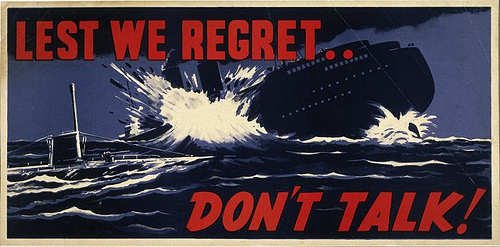
Christian Leaders and the “Don’t Talk” Rule

A Biblical Perspective on Spiritual Authority and Critical Thinking

4 Comments

Brother’s Keeper or Big Brother? 15 Signs of Surveillance in Your Church

We’re back to our series entitled “Frankenstein Faith” about scriptural distortions in the church and how to correct them. [You can see other posts in this series at the end of this post]

Big Brother is Watching

via The Student Review

In George Orwell’s famous dystopian book, 1984, the main character is ever aware of the presence of “Big Brother” looking on. In our culture, “Big Brother” has come to symbolize the surveillance—whether electronic or personal—necessary to keep citizens in line in a totalitarian environment. Surveillance creates a climate of fear by exposing and punishing even the slightest offenses.

My wife and I just watched a National Geographic special on North Korea—the world’s most totalitarian state. The behavior of the North Korean people—their fear, the way they act around government officials, their evident brainwashing, and their worship of their dictator—all triggered memories in me of my former Bible cult.

This post is about surveillance in spiritually abusive or cultic churches. Indeed, in spiritually abusive churches even thought-crimes and attitudinal sins are brought before the leader(s). This results in erosion of trust among families and friends, creates a climate of fear, and leaves the cult leader or abusive pastor in absolute control of the group.

It should go without saying that this is unbiblical, but Christian groups who practice surveillance use several Bible passages to justify their behavior.

5 Bible Passages Used to Justify Surveillance in the Church

1.) Genesis 4:9 – After Cain murders his brother Abel, God asks Cain where his brother is. Cain replies indignantly, “Am I my brother’s keeper?” In evangelical circles, this phrase has come to symbolize the idea that each Christian is responsible for the welfare of his fellow believers. Not a bad concept. But in my former church, my pastor used the phrase as a way to guilt us into tattling on fellow church members who stepped outside the intricate network of manmade rules he created. To be a “brother’s keeper” meant to report any behavior which appeared to go against the pastor’s legalistic interpretation of the Bible.

2.) Leviticus 5:1 – “If a person sins because he does not speak up when he hears a public charge to testify regarding something he has seen or learned about, he will be held responsible.” Cult leaders use this verse to instill fear in their followers. They’ll say, “I’m telling you right now to report any infractions to me. This is for the good of your fellow believers so that they will not continue in sin. And it is for your own good—so that you will not be guilty of complicity.” But the context in Leviticus is a theocracy in which both civil laws and religious laws were clearly stated. It does not mean that a pastor can use this verse as a sweeping, perpetual directive for church members to spy on each other for supposed infractions of the leader’s rules, whether spoken or unspoken.

3.) Ezekiel 3:16-21 – This passage is where God calls the prophet Ezekiel a watchman for the house of Israel. God tells him to warn wicked people about their sins. If Ezekiel doesn’t warn them, says God, he becomes guilty of their blood when God judges them. Yikes. Our pastor used this passage to say that any member of the congregation who failed to report another’s sin to the pastor would be guilty of complicity. In our pastor’s parlance, “sin” actually meant anyone who spoke against the pastor, spoke ill of the church, demonstrated attitudinal sins (questioned the pastor’s teachings or complained about the strict rules), or broke any of the infinite number of manmade rules created by my pastor.

Peace, Hope, Surveillance

via Get Directly Down, Creative Commons

4.) Zechariah 13:3 – “If anyone still prophesies [falsely], his father and mother, to whom he was born, will say to him, ‘You must die, because you have told lies in the Lord’s name.’ When he prophesies, his own parents will stab him.” This cheerful verse is used by some cult leaders to create surveillance networks within families. But the context is the Second Coming of Christ and the beginning of the Millennial Kingdom. It is a hypothetical scenario showing the state of purity on the earth at that time. It doesn’t mean that Christians today must take draconian measures against family members who step out of a pastor’s favor.

5.) Luke 12:2 – Jesus tells his followers that what is whispered in private will be shouted from the rooftops. Cult leaders use this verse to destroy boundaries of privacy, saying that nothing is off-limits from the eyes of the pastor. The context of the verse, however, is Jesus’ rebuke of the Pharisees for their hypocrisy. Jesus warns his followers that people who live hypocritical lives—that is, they act one way in public and another way in private—will be exposed for what they are before the world. This is not a license for pastors to destroy reasonable expectations of privacy.

15 Signs That Your Church Has Surveillance:

  1. Climate of fear.
  2. Things you say in private—whether to other members or to the pastor in counseling—are exposed in public.
  3. You can’t trust anyone to keep a confidence. Therefore, you always end up saying the “party line” even if you don’t agree.
  4. Your pastor ignores church discipline protocols (Matt 18; 1 Cor 5) and tells everyone to immediately report concerns about other believers directly to him or her.
  5. Public shaming and punishment for private matters.
  6. Thought-Control: Group members are told to confess “attitudinal” sins such as pride, selfishness, and critical thinking.
  7. You alter your behavior when other church members are present.
  8. When out in public, you fearfully scan the grocery store or parking lot for other church members.
  9. You are afraid to disagree with your leader, no matter how wrong he or she appears.
  10. Confession is rewarded; silence is punished.
  11. Invasion of privacy: no healthy boundaries or reasonable expectation of privacy. Nothing is “off limits” for the pastor. The pastor may demand to read your emails, journals, or text messages; examine your home for evidence of “sin”; or demand that you confess to sinful thoughts or feelings.
  12. Lack of perspective: even minor or imagined infractions are punished severely.
  13. Defending yourself against accusations is labeled as “rebellious.”
  14. Catastrophism: The pastor gives dire warnings about what will happen to you if you refuse to report “misbehavior” of fellow members.
  15. The leader has a privileged status and is immune from scrutiny.

Conclusion

If you come from a healthy church background, this all sounds bizarre. But if you come from a cult or a spiritually abusive church, it rings familiar.

Big Brother is watching.

Posts in this Series:

Fixing a Frankenstein Faith: Ten Distortions of Scripture and How to Correct Them

Distortion #1: Love Thy Neighbor But Hate Thy Parent

Distortion #2: “Because I’m Your Pastor/Elder/Spiritual Leader, that’s Why!”

Distortion #3: Vestigial Organs in the Body? Natural Family vs. Spiritual Family

Distortion #4: Brother’s Keeper: Surveillance in Spiritually Abusive Churches

Distortion #5: “It Says in Deuteronomy…”: Misuse of the Old Testament

Distortion #6: God or Mammon: Logical Fallacy of the Excluded Middle

Distortion #7: I Committed Adultery Watching the Smurfs: James 4:4 Unpacked

Distortion #8: You Shall Be Holy Unto Me (So Ditch the Budweiser)

Distortion #9: “We Alone are the ‘Remnant,’ all 75 of Us!”

Distortion #10: Fun in the Shun? Confessions of an Excommunicator

9 Comments

The Strange Trial of 1 Timothy 2:12

In the spring of 2014, in a small courtroom in the quiet town of Public Opinion, Ohio, 1 Timothy 2:12 stood trial. The charge? Discrimination against women and crimes against humanity. You probably remember reading about it in the paper.

I was a cub reporter in those days, still wet behind the ears and eager to prove my mettle. I was working the local beat before heading to the big city to make my name.

It was one of those warm April afternoons, the kind that makes you forget about winter and makes you want to walk a little slower between your car and the office. Yellow daffodils paved the courthouse lawn, fighting off a few purple iris rowdies. I had bought a sandwich from Sam’s—pastrami and Swiss in greasy paper—and was thinking about one thing and one thing only: whether the Buckeyes would have a fighting chance at the College World Series.

courtroom

Clyde Robinson, Creative Commons

The Court of Public Opinion wasn’t much to look at: stone building, dark wood rooms in need of natural lighting, the usual set-up with judge’s bench, jury box with a dozen nondescript people, and spectator seating. You’ve probably seen something like it in your town.

I wasn’t expecting much.

I sat off to the side where I could wedge my feet against the back of the bench in front of me and eat my sandwich with a reasonable expectation of privacy. I laid my pen and yellow legal pad next to me and started to unwrap the sandwich. That’s when the bailiff stepped into the room.

“All rise!”

I dropped the sandwich and stood with the dozen or so other loosely affiliated spectators you’d expect to see on a nice Monday afternoon. Soon I forgot about my sandwich or my notes.

The bailiff’s voice rang out: “The case of 1 Timothy 2:12 vs. Women and Humanity. The honorable Brabus Evenly, presiding.”

The judge glided in from his chambers, gown billowing.

“Be seated.”

We settled heavily.

I glanced at the defendant’s table. A middle-aged man sat in an ill-fitting suit next to his attorney. I was surprised to see that she was a woman–a Ms. Sharp. “Crimes against women?” I thought. “Did she not get the memo?” I could only see the back of her head—blond hair in a tight French braid—but she looked put-together and more intelligent than the court of Public Opinion usually attracted.

I turned to the prosecution. Three attorneys sat at the gleaming table, all in expensive suits and snappy accessories. The chief prosecutor—the one in the middle—was also a woman. “Ms. Candide,” read the nameplate on her desk. She wore a sharp black blazer, starched white blouse, and had red hair pulled severely back.

After opening arguments—the substance of which I forget but which you can read in the newspapers—the prosecutor called her first witness: a Ms. Harriet Spielman from Cumquat, Ohio.

The Prosecution

Witness 1: Ms. Spielman

After taking her oath, Ms. Spielman sat down in the witness stand, her face red and her hands tugging at her dress.

“Ms. Spielman,” said the prosecutor, “can you tell me about your church?”

“Yes ma’am. It’s a Baptist Church. About 200 people. Pastor’s from one of those big seminaries down south.”

“And this pastor is a man, I presume?”

“Yes ma’am. We’ve always had a man for a pastor.”

“I see. And when this pastor retires or leaves, who will be your next pastor?”

“I’m not sure.”

“I mean, will you have a male or a female pastor?”

Ms. Spielman chuckled. “Oh, it will be a man, all right. That’s all we’ve ever had, and it’s all we ever will have, you can be sure of that.”

The prosecutor looked at the jury, then back at Ms. Spielman.

“And why can we be sure of that, Ms. Spielman?”

“Why, because of Mr. 1 Timothy sitting over there. He says that a woman can’t teach a man or have authority over a man. Plain as the hand in front of your face.”

“And has anybody in your church ever questioned this idea, Ms. Spielman?” The prosecutor sounded gentle, like she was petting a kitten.

“Oh no! How could we? It says so in the Bible and we fear God. There won’t ever be a female pastor in our church, you can be sure of that.”

country church

Via Forest Wader, Creative Commons

The prosecutor cocked her head to the side. “But Ms. Spielman, surely you know that other churches have female pastors.” She walked back to her desk, picked up a sheet of paper, and began to read: “The Lutherans, for example. Or the Methodists. Episcopalians. Assemblies of God. African Methodist. Mennonites. The Vineyard Movement. The Presbyterian Church, USA. Pentecostal Holiness Church. Wesleyan. United Church of Christ. The Quakers.” She walked back to the witness stand. “These groups compose millions and millions of Christians. Do you think your church of 200 people is right and all these millions of people are wrong?”

“I don’t know about that,” said Ms. Spielman. “And I can’t speak for the hearts of those folk. But I know that we Baptists fear God and take the Bible as his inspired word, without error. And since it says there in 1 Timothy 2:12 that women can’t teach or have authority over men, why, that’s what we have to follow.”

“But do you think all these other folks are wrong in what they’re doing? Aren’t they captive to the Word of God, as you say you are? Don’t you ever wish that a woman who clearly has the gift of leadership could lead in the church?”

Ms. Spielman looked flustered. “It doesn’t matter what anyone else does. Doesn’t matter what we think. Doesn’t matter what we wish. Our conscience is captive to the Word of God. And anyway, women in our church can lead. They lead the children’s ministry and women’s groups. We even have some deaconesses who help out planning the potlucks and visiting the sick.”

“But don’t you feel like you’re missing out, Ms. Spielman? That you’re being discriminated against? Don’t you feel offended that you can teach women and children the Word of God, but never a man? Don’t you think Paul was a misogynist and that the Church has oppressed women and that this all misrepresents the heart of God?”

“Objection!” shouted the defense. “I don’t see how the Church’s behavior through history can be pinned on my client. The Church has done a lot of things in the name of God which are not reflective of scripture.”

“Sustained,” said the judge. “Ms. Candide, I ask you to keep your questions to the exact text and direct application of 1 Timothy 2:12.”

Ms. Candide nodded. “Thank you, Ms. Spielman. No further questions.”

The judge looked at Ms. Sharp. “Does the defense have any questions for the witness?”

“Not at this time.”

Ms. Spielman climbed down from the box and returned to the gallery. A man in a flannel shirt patted her shoulder and put his arm around her. She looked winded.

Witness 2: Dr. Erudite

The prosecutor called her second witness: a Dr. Erudite, from the religion department at the local university.

After taking the oath, Dr. Erudite sat in the witness box, cool and composed, red tie matching his brown herringbone jacket.

Ms. Candide smiled. “Dr. Erudite, can you state your name and occupation for the record?”

“Dr. Bart D. Erudite,” he said. “James T. White professor of Religious Studies at Wheatgerm College. Expert in New Testament Studies and Greek.”

“Thank you, Dr. Erudite. In your opinion, has 1 Timothy 2:12 been the flagship verse used to support Hard Complementarianism and the oppression of women in the church?”

“Objection!” shouted Ms. Sharp. “The opinion of the professor can hardly be called evidence in this trial of my client and his supposed crimes against humanity.”

“Overruled,” said the judge. “Dr. Erudite’s opinion is germane because of his field of expertise. If he has thoughts about this, I’d like to hear them.”

Ms. Candide smiled. “Thank you, your honor. Dr. Erudite, in your expert opinion, is 1 Timothy 2:12 the primary proof-text for the church’s discrimination against—and oppression of—women?”

The professor furrowed his brow. After the exchange between attorneys, he seemed to pick his words even more carefully. “While I can’t say that it is the cause of all oppression and discrimination against women in the church, it seems to me the primary verse used to prevent women from attaining roles of leadership such as pastor or elder in the church. Insofar as women may be gifted for or desire such positions, I would say that this verse creates a glass ceiling and may even lead to harsher interpretations which can result in abusive behavior toward women.”

I looked quickly at the defense and saw Timothy’s shoulders slump. He shook his head slightly and whispered something to his attorney.

SNappa2006, Creative Commons

SNappa2006, Creative Commons

“Indeed,” said Ms. Candide. “And do you find any evidence from sociological studies to affirm the stated reason for 1 Timothy 2:12, namely, in verses 13-14 where the author appeals to the biblical account of the created order and the deception of Eve as justification for why women should be prohibited from teaching or having authority over men?”

“Objection!” the defense attorney said. “The doctor is not an expert in sociology, nor are we discussing verses 13 and 14, per se.”

“Do you have any background in sociology, Dr. Erudite?” the judge asked.

“I do on this particular topic, your honor. I have teamed with Dr. Ernst Humboldt, renowned sociologist at the University of Cornucopeia, to study deception in both men and women. In our studies, men are just as likely—or sometimes even more likely—than women to be deceived by a stranger.”

“Very well,” said Judge Evenly. “I’ll allow the doctor’s opinion on this particular matter.”

Ms. Candide stepped back. “No further questions, your honor.”

“Does the defense have any questions for the witness?”

“Not at this time, your honor.”

The Prosecution’s Final Witness

After Dr. Erudite stepped down from the stand, the prosecutor called her third witness, and the courtroom filled with excited rustling: it was 1 Timothy 2:12.

He stood and shuffled over to the witness stand.

The bailiff brought a Bible and administered the oath: “Do you swear to tell the truth, the whole truth, and nothing but the truth, so help you God?”

“I do.”

“State your name, age, and occupation for the record.”

“1 Timothy 2:12. 1,950 years old, but,” he smiled, “that depends on your calendar. I’m a descriptive and prescriptive Bible verse written by the Apostle Paul.”

I noticed he had a thick accent, hard to place.

The prosecutor stood in front of the stand, her arms crossed. “Mr. Timothy, you realize, don’t you, that you have injured and oppressed millions of women since you were penned?”

“Objection!” Timothy’s lawyer jumped to her feet. “It is for the court of Public Opinion to decide Mr. Timothy’s guilt or innocence. My client cannot be asked to self-incriminate.”

“Sustained,” Judge Evenly said. “Pursue another line of questioning, Ms. Candide.”

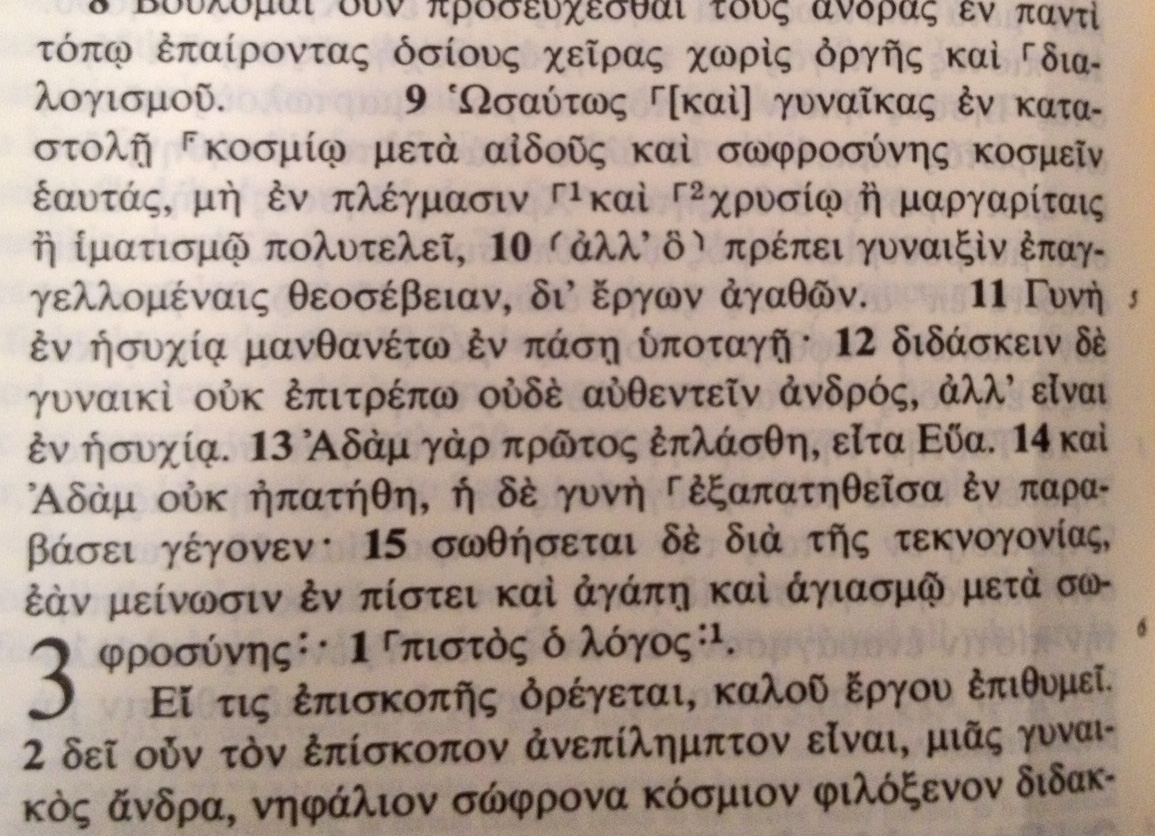
“Very well. Mr. Timothy, doesn’t your text read, ‘But I do not allow a woman to teach or exercise authority over a man. She must remain silent.’?”

He shifted in his seat, eyes quizzical. “Is that how you translate it?”

“Mr. Timothy, a simple ‘yes’ or ‘no’ will be fine.”
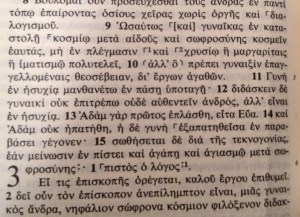
1 Timothy 2:12“But it is not so simple,” he said. He had a mustache that curled up in beautiful little handlebars, and he began to twist one of the ends. “I am an immigrant, after all, and my English is imperfect. I understand that there are various ways to translate my verse into English. I was written first in Greek, you see, and the word you translate ‘woman’ can also be translated ‘wife.’ And then there’s the matter of ‘authority,’ which more precisely…”

Ms. Candide stiffened. “That’s enough, Mr. Timothy!”

Judge Evenly chimed in, “Mr. Timothy, you will stick to simple answers. The defense will have an opportunity to cross-examine.”

Timothy nodded. “Very well. But since I am Greek, should I not be judged in Greek and not in English? After all, it hardly seems fair to prosecute me for a translation performed by other men and for actions done by others. Why are the translators not in this seat?”

“Because they’re all dead, Mr. Timothy, and you remain distressingly alive,” said Ms. Candide.

“But I am Greek, and you are American,” said Timothy. “It doesn’t seem fair to judge me for the work of other men. Better to judge me in the context of my peers—the context in which I was written, and the culture in which I was born.”

“Mr. Timothy, your words have been used by all subsequent generations to subjugate and oppress women: from the early church fathers to the Catholic Church to the Protestant Reformation to the modern day evangelical church. Do you really expect this courtroom to believe that in your day your words meant something entirely different, and that women were free to lead in the church? Seriously?”

Timothy shrugged. “Believe what you want. But to be fair you must judge me in context, and in Greek. Never judge a verse by its abuse, but rather by its original intent.”

“So you deny the accuracy of the translation I just quoted?”

Timothy looked at his attorney.

She nodded her head.

“I do,” he said. “It’s inaccurate.”

Ms. Candide looked frustrated. “So are you telling the court that the traditional English translations have completely mistranslated you? Does that sound very reasonable? After all, each English translation was the product of a team of experts…”

“…each of whom was a product of his particular culture and who possessed his own particular biases,” Timothy interrupted. “But I was written in Greek, so you should judge me in Greek and not in English. It is no fault of mine that I was mishandled.”

Open Bible

Ryk Neethling, Creative Commons

“Are you telling me that the entire Bible is untrustworthy? If your verse has been so grievously mistranslated, how can we assume that other passages are unaffected? Does everyone have to know Greek to get the gist of God’s Word? Wouldn’t that just give us a billion different translations?” She seemed genuinely puzzled.

Timothy looked unruffled. “No translation is perfect in every regard. It’s a dynamic process. Translators are just people, locked in their own culture and with their own particular traditions and biases. They all do their best, and that’s pretty good—especially in regard to major doctrinal points. By working in teams they pool their expertise and help cancel out personal biases. But in my case, they got the translation somewhat wrong. On the other hand, they got it sort of right, too, but that’s because…”

The prosecutor interrupted. “So how would you translate yourself?”

“Objection!” Timothy’s lawyer shouted. “Self-incrimination.”

“Sustained,” said the judge.

“Actually, I don’t mind,” said Timothy. “I think it might…”

“No!” said his lawyer.

Timothy looked surprised. “But…”

“No,” she repeated.

He shrugged his shoulders.

The prosecutor sighed. “No further questions, your honor.”

Judge Evenly raised an eyebrow. “No further questions? Very well, Ms. Candide. Does the defense have any questions for the witness?”

Timothy’s lawyer shook her head.

The judge nodded. “You are dismissed, Mr. Timothy. Does the prosecution have any other witnesses?”

“The prosecution rests.”

“Then the defense may call its first witness. Ms. Sharp, whom do you call?”

The Defense

The defense attorney stood. “I call only one witness, your honor. Dr. Ken Keener, professor of New Testament at Hosanna Bible College. He is a Greek scholar and also a world-renowned expert on the cultural background of first-century Ephesus.”

A small, mouse-faced man walked to the witness stand. After taking the oath, he sat in the box, all elbows and thick glasses.

Ms. Sharp said, “Dr. Keener, you’ve studied 1 Timothy 2:12 for quite some time, isn’t that right?”

Keener looked over at Timothy and smiled. “Indeed. You could almost call us old friends.”

“And you have a different interpretation of the verse?”

“I do.”

“Could you share that with the Court, please?”

Keener shifted in his chair. “Certainly. The word in this verse for ‘authority’ is not the normal term Paul uses elsewhere in his writings. In fact, it is the word authentein, which occurs only here in the New Testament. That makes it a little tricky to determine the exact meaning, but many scholars—and I am one of them—believe it has the nuance of ‘domineer.’”

“Objection!” said the prosecuting attorney. “What the doctor believes is not the question. Bible scholars for centuries have translated this word as ‘authority.’ Why would he be right and all of them wrong?”

The judge motioned for silence. “Do you have evidence for your opinion, doctor?”

“I do. If Paul had wanted to use the word ‘authority,’ he would have almost certainly used the word exousia, which means ‘power’ or ‘authority.’ It occurs dozens of times in his writings and was the common word with a clear meaning. For him to choose a different word—indeed, a unique word—strongly implies a different nuance in meaning. I believe authentein has the nuance to ‘domineer’ or ‘lord it over.’ In extra-biblical writings in the 6th century B.C., it meant ‘to initiate or be responsible for a murder.’ In the first century A.D., it usually meant ‘to be, or claim to be the author or the originator’ of something.”

“Very well,” said Judge Evenly.

“But there’s more,” said Keener. “Since Paul refers to the creation order in 1 Tim 2:13-14, it is not unreasonable to assume he may have had in mind Genesis 3:16 where God said that the woman would ‘desire’ her husband. When the Septuagint translators rendered the Hebrew for this verse into Greek, they chose the word kurio, which means to ‘lord it over’ someone else. The curse in Genesis 3 is not that a wife will desire her husband (what’s wrong with that?), but that she will want to lord it over him. Paul would have been well familiar with this translation.”

“Objection!” the prosecutor shouted. “Speculation!”

“Do you have more evidence that this may have been the apostle’s intent in 1 Timothy 2:12?” asked the judge. “Otherwise, I would have to agree that it sounds quite speculative.”

artemis of the ephesians

Artemis of the Ephesians, via Son of Groucho, Creative Commons

“In fact, I do,” said Keener. “The cultural background of Ephesus and the context of 1 Timothy 2:12 both provide clarity. Paul wrote to Timothy while the latter was staying in Ephesus. Ephesus was the center of the cult of Artemis—there were other cities who worshiped Artemis, but those were like franchises of the primary deity. Built in the 6th century B.C., the Temple of Artemis in Ephesus was one of the seven wonders of the ancient world. While Artemis has often been thought of as the goddess of fertility, in the Ephesus franchise she was actually the goddess of war and of childbirth. The ‘breasts’ on her sculptures appear to form scales of armor”—here the prosecutor snorted loudly, but Keener continued—“which also appear on certain statues of Zeus as pectoral armor.” He looked pointedly at Ms. Candide. “I have pictures if you want to see them.”

She nodded.

“Then I present Exhibit A, pictures of both Artemis and Zeus with this pectoral armor.”

The bailiff retrieved the photos from Ms. Sharp and brought them up to the judge. Judge Evenly looked at them, then held them up for the rest of the Court to see.

Ms. Candide walked up and scrutinized the pictures. “Looks like breasts to me,” she said.

Keener laughed. “I can understand that perception, but it doesn’t make sense that Zeus would have the same appendages. Artemis was a warrior goddess, and it makes more sense that these represent pectoral armor.”

“I don’t see what any of this has to do with 1 Timothy 2:12,” Ms. Candide said. “Your honor, can the defense’s witness please get to the point?”

Judge Evenly nodded. “The witness will please connect the dots for the benefit of the Court,” he said.

Keener sat straighter in the box. “Certainly. This is all part of the cultural background of Ephesus, the context Paul had in mind when he wrote the letter to Timothy. The adherents of Artemis were quite domineering towards men. They believed that women should rule over men, and they also believed that woman was created first, rather than man, since Artemis was born the day before her twin brother Apollo. And they believed that Artemis would protect women in childbirth if they prayed to her. Further, Jewish Gnostics in Ephesus believed that Eve was the illuminator of humanity because she was the first to eat the fruit from the tree of the knowledge of good and evil. She then supplied this gnosis (true knowledge) to Adam.”

Ms. Candide sighed loudly and rolled her eyes.

Keener looked around the room. “May I continue?”

The judge nodded.

“Okay. We see these same elements addressed specifically by Paul in 1 Timothy 2:9-15. In verses 8-11 he says that women should dress conservatively and modestly, practice good deeds, and learn respectfully. This would have contravened the practices of the brash, domineering adherents of the cult of Artemis. In verse 12, he says that Christian women in Ephesus should avoid domineering the men. Paul can’t mean that women must remain silent entirely, because in 1 Corinthians he permits them to prophesy and speak in tongues in the church. He also allowed Priscilla to teach Apollos; included Junia among the apostles; mentions Phoebe as a deaconess; appears to make provision for female elders (this is debatable—I won’t press the point); and greets numerous females as co-laborers in his work. For Paul to order all Christian women at all times to remain silent in the church would defy the rule of noncontradiction.”

Judge Evenly stared at Keener but said nothing. The jurors seemed lost. But Timothy, I noticed, was nodding his head vigorously during Keener’s soliloquy.

ephesus

Ephesus, via Nikonic, Creative Commons

Keener continued: “In verses 13-14, when Paul talks about Adam being created before Eve, and about Eve being deceived (rather than enlightened), he directly opposes the corresponding Artemis and Gnostic myths. Remember that later, in 1 Timothy 4, Paul commands Timothy to have nothing to do with godless myths or endless genealogies. It is likely that these were the Artemis reverse creation myths he was referring to. Finally, in verse 15, Paul seems to use a quote, ‘she will be saved through childbearing.’ If it is a quote from the cult of Artemis, it solves the grammatical switch in number from the singular ‘she’ to the plural ‘they.’ The cultural background in Ephesus gives a strong reason for Christian women to especially fear childbirth. Perhaps Paul was saying that Christian women would not die in childbirth in Ephesus as a sign to the culture that Jesus was stronger than Artemis. Maybe it was a proof sign. It is not true of all women in all times.”

Keener fell silent and looked around at the Court. I couldn’t see Timothy’s face, but his ears rose in what had to be a wide smile.

It all seemed overwhelming to me. I wasn’t exactly sure what Keener had just said.

His lawyer stepped in. “So let me get this straight, Dr. Keener. You’re saying that 1 Timothy 2:12 is not guilty of oppressing women because Paul wrote the verse to address particular problems with a particular cultural context in mind?”

Keener nodded. “Exactly. All of this helps to explain 1 Timothy 2:12 in its biblical context as a culturally-specific command. All Scripture is for all time, of course, but not all Scripture is for all circumstances. We can extract some principles of relating respectfully to one another in this verse, but it was never meant to apply to all people at all times. The verses around it help to explain this. Faithful Christian women have sometimes died in childbirth down through history, and faithful women have sometimes taught men.”

Even Ms. Sharp seemed stunned with everything Keener had said. She turned toward the judge. “I have no further questions, your honor.”

The judge looked over at Ms. Candide. “Would the prosecution like to question the witness?”

Ms. Candide stood. “Yes, your honor. Just one question.” She walked to the witness stand and stood in front of it. “Dr. Keener, if you put a brick on your car’s accelerator and forget to take it off, are you liable for the damage your car causes, even if you intended to hit the brakes?”

Keener looked confused. “Come again?”

“Objection!” shouted the defense. “Is counsel going somewhere with this?”

“I would appreciate a correlation, Ms. Candide,” said the judge.

The prosecutor stood with her hands on her hips. “Just this: even if everything Dr. Keener has said is true and 1 Timothy 2:12 is culturally-specific, it doesn’t say so explicitly in the text. The original audience might have known it was intended for a specific cultural scenario, but how are we supposed to ferret it out? No one ever put their foot on the brake to stop this verse, and look what damage it has caused to women for the past 2,000 years.”

“1,950!” Timothy piped up.

Ms. Candide ignored him. “Isn’t it reasonable in such a case, Dr. Keener, to hold Mr. Timothy responsible for the damage his language has caused?”

For a moment, Keener said nothing. Then he smiled and said, “Unless the car was hijacked.” He turned toward the jury and waved his hand in their direction. “But I suppose that is for the jury in the Court of Public Opinion to decide.”

I suppose I don’t have to tell you what the verdict was, do I? You probably already read about it in the papers.

As for me, I walked out of that courtroom with a lot to ponder. I was so busy thinking, I even forgot my pastrami sandwich. Left it right there in its greasy paper.

After a lot of thinking, I did come to a settled opinion about the whole matter–but I guess that’s a story for another time, isn’t it?

Related Posts:

The Myth of Biblical Manhood
What’s at Stake in the Gender Debate

24 Comments

To Train Up A Child…. Abuser (Part 2)

Open Bible

Photo by Ryk Neethling, Creative Commons

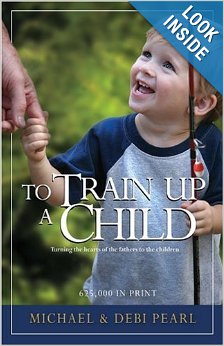
This is the second part of a post about the abusive teachings of Michael and Debi Pearl’s book, To Train Up a Child. You can read the first part here.

5.) Faulty Theology – Pearl’s entire “training” system is built on the speculative premise that children must be trained to obey a parent without question until they reach the age of moral accountability. While the age of accountability remains a popular part of Christian mythology, it lacks specific biblical support. If it is true, it is true because of the merciful heart of God and not because a Bible verse explicitly says it is so. But Pearl takes it as a matter of absolute dogma and then constructs his entire system of training on the premise that parents are guardians of a child’s morality until the child reaches the age of accountability—somewhere between the age of five and twenty. Yes, you read that right: according to Pearl, there is a subjective gap of fifteen years during which your child, according to Pearl, might reach the age of moral accountability:

“The child is not a morally viable soul. He is an incomplete moral being. He is not accountable. Morally, the three-year-old is still in the womb. Moral life begins its development sometime after birth, probably in the second or third year, and continues until it matures at about ten to fifteen years of age. Like physical development in the womb, moral development is a slow transition from no moral understanding at birth to complete accountability at some point in the child’s youth. There are vast differences of opinion as to when God holds a child accountable for his own actions and thoughts. From time immemorial, age twelve has been the traditional ‘age of accountability.’ But accountability is not an age; it is a state of consciousness (James 4: 17; Lev. 5: 3). Biblically, it will be sometime before twenty years of age (Deut. 1: 39 with Num. 14: 29-31). Observation seems to suggest that some children may be accountable as early as five, while others may not be fully accountable until nineteen.”

Clear as mud, right? For such a sober responsibility as holding a child’s moral development in your hands, it might be nice to have a clearer biblical standard beyond the so-called wisdom of “time immemorial.” Pearl seems to understand the fuzziness of his argument, so he elaborates:

“God will not condemn a child until he has grown into a state of accountability. However, during this ten or twelve year transition, which generally occurs between the ages of about two and fourteen, the child’s accountability will increase with the growth of his moral awareness. When a child goes against his conscience, however limited and incomplete his understanding may be, he is then guilty. The degree to which his understanding has developed is the degree to which his actions can be called sin. The presence of guilt is a good barometer as to how much his conscience has developed. Again, though the child may feel guilt in some areas, the responsibility for sin is not imputed unto him until his moral soul is fully functional. An unfinished clock, still in the making, may have moving parts, but it will not keep time until every last piece is properly installed.”

This is not biblical theology. It is speculation, based on Pearl’s own personal preferences, suppositions, and biases. But the rest of the book is predicated on its absolute truth:

“Where the child possesses moral understanding, yet disobeys, he should be chastened with the rod. Where he does not understand the moral quality of his actions, he should be trained and conditioned.”

Did you catch that? Either way—whether the child understands or doesn’t understand, you get to beat him. Apparently beating is good for a child’s soul. The reason, Pearl says, is because the parent acts as the “law” for the child in order to bring the child’s flesh into complete subjection:

“Even before a child’s conscience begins to operate, you must train him to practice self-restraint. For if a child is allowed to violate his budding conscience, and continues to do so as he grows to full maturity, he will find himself already fully given over to his flesh long before he begins to develop a sense of duty. Therefore, before moral development even begins (at about two years of age), parents must bring the child’s flesh into complete subjection. By the third year and beyond, that part of the child that is awakened to moral duty should be taught to voluntarily surrender to the rule of law. If you allow the flesh to run its natural course, the child will be possessed of many unruly passions and lusts long before he is cognizant enough to assume responsibility.”

Potter and Clay

Photo by Walt Stoneburner, Creative Commons.

This puts tremendous pressure on the parent who is held responsible for the child’s moral development. Says Pearl: “If God is the potter and your child is the clay, you are the wheel on which the clay is to be turned.” The parent’s role goes even deeper, says Pearl, into the realm of the Holy Spirit: “You can begin the child’s ‘sanctification’ long before his salvation.”

The twisted root of this book is a false theology which puts parents in the sanctifying role of the Holy Spirit, gives their beatings the efficacy of the blood of Christ to remove guilt, and reverses the biblical order of justification and sanctification. Don’t believe me? Read on:

“Christians find release from their guilt through the Savior who suffered the curse of their sins, but their children cannot yet understand that the Creator has been lashed and nailed in their place. Yet, parents need not wait until their children are old enough to understand the vicarious death of Christ to purge their children of guilt. God has provided parents with a tool to cleanse their children of guilt— the rod of correction.”

Just think, parents! You can cleanse your child from guilt by beating them with a wooden rod. This puts you in the role of Jesus Christ, or at least it puts the father in the role of savior:

“Father, as high priest of the family, you can reconcile your child to newness of life. Guilt gives Satan a just calling card and a door of access to your child. In conjunction with teaching, the properly administered spanking is restorative as nothing else can be. A spanking (whipping, paddling, switching, or belting) is indispensable to the removal of guilt in your child. His very conscience (nature) demands punishment.”

You read that right. Pearl believes that parents can expiate the guilt of their children by beating them. This helps to explain why he advocates with such aggressive zeal for beating infants and children.

So what are the consequences of disagreeing with Michael Pearl’s misinterpretation of the Bible and his mistaken theology? Why, to make little Hitlers out of your children, of course! Pearl says: “Fail to use the rod on this child, and you are creating a modern-day ‘Nazi.’”

There’s your choice, parents: either beat your children and save them through their own blood, or refrain and turn them into bantam Hitler youth.

But in reality, To Train Up a Child is not biblical and the choice is not binary. It is just rules taught by men.

6.) Destruction of Personhood – One of the greatest abuses of To Train Up a Child is the destruction of a child’s personhood. The Bible says that all people are created in the image of God, the so-called imago Dei, which theologians have traditionally interpreted to mean that we are created as people, separate from the animals.

Jesus Portrait

Photo courtesy MAMJOHD, Creative Commons

What defines personhood? Three things: intellect, emotion, and will. In the Pearls’ economy, children should be broken in each of these three areas using the same training techniques one would use with animals. This effectively mars the three-fold personhood of children and reduces them to people-like robots. Here’s why:

a.) Destruction of a child’s intellect – Michael Pearl demands that children give instant, unquestioning obedience to their parents (and to all adults):

“I have taught the children to obey first and ask questions later. When they were small and I would put them through paces, they learned to immediately do what I said. If they ever failed to instantly obey a command, I would ‘drill’ them. ‘Sit down,’ I would say. ‘Don’t speak until I tell you to.’ Understand, I was not taking out my frustrations on them. It was all done with utmost pleasantness. ‘Stand up,’ I would command. ‘Now, come here. Go touch the door.’ And, before they could get there, ‘Sit.’ Plop, down they would go. ‘Now, go to your rooms and clean them up.’ Just like little, proud soldiers, off they would go to the task. They thought it was just a fun game. If one of them should fail in his attitude, he would be spanked—without haste or hostility, mind you…. Even today, without looking at the children, I can snap my finger, pointing to the floor, and they all (including the ones over six-feet) immediately sit. I can point to the door, and they all exit…. Teach your children to ‘snap to it.’ They will be better for it, and it will make them more lovable.”

But does the Bible really teach parents to exact instant, unquestioning obedience from their children? Does God want parents to act like martinets, putting their children through ridiculous games designed to program them into mindless obedience? Doesn’t God invite questions from his children?

b.) Destruction of a child’s emotions – Pearl says that he made a commitment not to raise “sissies” or “crybabies.” Instead, he delights to toughen his children like little soldiers who ignore pain, accept mistreatment, and refuse to tell their parents when they have been abused:

“For your children’s own good, teach them to maintain control of their emotions. If you do not want to produce sissies who use adversity as a chance to get attention, then don’t program them that way…. When I was just a young father, I had already determined that I would rear no sissies. If an infant fell and bumped his head, we pretended to ignore it. In the event one of our toddlers took a spill, we let him lie, whimper a second, and then climb back up for another try. Sometimes a toddler would fall out of the wagon or stumble into the dirt; we let him deal with it. When the young ones wrecked their bicycles and skinned their knees, we paid no attention except to say something like, ‘You shouldn’t go so fast until you learn to ride better.’”

This calcification of emotion—hardening against any response to pain and labeling a whole range of emotion the realm of “sissies” and “crybabies”—makes children less than God intended, not superior. Pearl is greatly mistaken to advocate this approach.

c.) Destruction of a child’s will – According to Pearl, the goal of “training” a child is to completely shatter the child’s will: “The child has just one will, which, when it is surrendered to authority on any point, is always a surrendered will.”

Total compliance is the goal:

“If a child shows the least displeasure in response to a command or duty, you should treat it as disobedience. If a child sticks out his lip, you should focus your training on his bad attitude. A wrong slant of the shoulders can reveal a bad frame of mind. Consider this a sign to instruct, train, or discipline. A cheerful, compliant spirit is the norm. Anything else is a sign of trouble.”

To this end, Pearl tells parents to use whatever force is necessary to break a child’s will. Pearl, himself a hulk of a man, sometimes sat on his children in order to beat them:

“Part of [the child’s] training is to come submissively. However, if you are just beginning to institute training on an already rebellious child who runs from discipline, and he is too disturbed to listen, then you must constrain him. If you have to sit on him to spank him, then do not hesitate. And hold him there until he has surrendered. Prove that you are bigger, tougher, more patiently enduring, and are unmoved by his wailing. Hold the resisting child in a helpless position for several minutes, or until he is totally surrendered. Accept no conditions for surrender— no compromise. You are to rule over him as a benevolent sovereign. Your word is final.”

Did you follow all this? In To Train Up a Child, Michael Pearl encourages parents to demand unquestioning obedience (stifling intellect), to toughen them up against pain and abuse (emotionally deadening them), and to completely shatter the child’s will. This effectively removes the personhood of each child and creates impersonal robots who do whatever an adult tells them to do. It effaces the image of God from children. Does this sound like the heart of God?

7.) Encourages Beating Infants and Children – This is the starting point for most of the articles and commentators who have expressed concern about this book. They rightly call such teachings child abuse. But I hope you can see that there is an entire twisted theology that leads up to this point and helps to explain why the Pearls teach people to beat their children.

8.) Examples of Child Abuse by Michael Pearl – While a Christian may come down on a spectrum in terms of whether it is ever appropriate to spank a child, there are several examples of child “training” which Pearl gloatingly gives which are undisputably examples of child endangerment or child abuse.

red hot wood stove

Photo by Tyler Karazewski, Creative Commons

First, Pearl left unguarded guns in full reach of his infants and children. When they toddled toward the gun, he would say “No” and beat them. He brags: “I didn’t child-proof my guns, I gun-proofed my children.” This is irresponsible by almost anyone’s standard.

Second, he practiced “safety-training” with a hot stove:

“We’ve always had a wood-burning stove for cooking and heating. A red-hot stove can seriously burn toddlers. I have seen some awful scars on other children. But we had no fear, knowing the effectiveness of training. When the first fires of fall were lit, I would coax the toddlers over to see the fascinating flames. Of course, they always wanted to touch, so I held them off until the stove got hot enough to inflict pain without deep burning—testing it with my own hand. When the heat was just right, I would open the door long enough for them to be attracted by the flames, and then I would close the door and move away. The child would inevitably run to the stove and touch it. Just as his hand touched the stove, I would say, ‘Hot!’ It usually took just one time, sometimes twice, but they all learned their lessons. Other than during the training session, where not even one blister was raised, we never had a child get burned. It was so effective that, thereafter, if I wanted to see them do a back flip, all I had to do was say, ‘Hot!!’ They would even turn loose of a glass of iced tea.”

Haha! How jolly it is to burn your children and then use that experience to program fear into them. Sick.

Oliver SmithThird, Pearl allowed his infant children [seven months to one-year-old] to play on the edge of a pond on the family property. He would let each child fall in; let them stay underwater until it registered that they couldn’t breathe; and only then rescue them from beneath the water. “It only took one time for each of them to learn respect for the water,” Pearl writes. “And it sure made life easier for us.” The only exception was his highly coordinated seven-month-old daughter Shalom, who just wouldn’t fall into the water on her own. So—you guessed it—Pearl pushed her in with his foot so that she felt that she was drowning. Nothing else would accomplish Pearl’s purposes of instilling terror of the water so Shalom wouldn’t play near the pond. I have included a picture of my almost seven-month-old son, Oliver, so you can see what age Shalom was when Pearl kicked her into the pond. Is this something God would approve of, do you think? Yet Pearl provides it as a shining example of child “training.”

Finally, Pearl wanted his small children to experience the dark side of life: “Expose them to death—the death of a pet or an accident victim… One or two examples to a three-year-old are enough.” Because a three-year-old clearly has the capacity to process carnage in a healthy manner, right?

9.) Fosters an Environment Which Enables AbuseBesides cultivating child abuse, the Pearls’ system of training children also creates an environment in which children are discouraged from reporting abuse and where parents are told to take the side of the abuser. Mothers who believe that their husbands are too harsh with the children have only one option:

“Mother, if you think your husband is too forceful in his discipline, there is something you can do. While he is away, demand, expect, train for, and discipline the children to give you instant and complete obedience. When Father comes home, the house will be peaceful and well-ordered. The children will always obey their father, giving him no need to discipline them.”

Michael Pearl expresses his disgust with children who “whine” or tell adults when they have been mistreated: “I can still remember when I was young, looking on with disgust as some swaggering brat sneered out of one side of his mouth and threatened to tell his mother [after he had been hurt by a bigger boy].”

don't talk rule

Keijo Knutas, Creative Commons

Instead of telling adults when you have been hurt or abused, says Pearl, children should keep silent. And parents should not become angry when someone mistreats their child. Instead, parents should believe adults who accuse their children of wrongdoing, considering that children will often use deceit and threats to manipulate any social relationship. This is a perfect recipe to enable child abuse to occur and to re-victimize victims. Lest the reader have any doubt as to Pearl’s position on this, he makes it explicit:

“It is not going to harm your child to be falsely accused a few times (that’s life). He will have to learn to deal with it sooner or later. When he is accused, if you have doubts about his guilt, patiently search out the matter. If you determine that he has been falsely accused, tell him, and then quietly drop the matter. Don’t let him see your defensiveness on his behalf. If he is roughed-up by his peers, rejoice; he is learning early about the real world. Don’t make a sissy out of him. If you jump to his defense every time another child takes away a toy, pushes your child down, or even pops him in the nose, you will rear a social crybaby. When you demand that your child be treated fairly, you are protecting him from reality. The younger they are, the easier it is for them to learn that they deserve no special treatment. Your reactions are not going to make life any less unfair for your child, but there is a danger of stirring up a feel-sorry-for-myself attitude in him. If you are tough, he will be tough.”

This is an abuser’s dream: to encounter children whose parents won’t listen to them, who have told them to suck it up and accept mistreatment, and who themselves have already beaten their children into submission. What a nightmare.

10.) Homeschooling Agenda and Reason for the Book’s SuccessThe reason the book has enjoyed such disproportionate success is because the Pearls are part of an evangelical subculture known as the Christian Homeschooling Movement. Let me hasten to say that this is not a monolithic entity: its expression varies widely. But there are hundreds of thousands of families (judging from book sales of To Train Up a Child) who fall on the fundamentalist, separatist side of the spectrum. These families eschew modern psychology (Pearl calls folks who believe in modern psychology a coven of “Sodomites” and “socialists”) and often isolate themselves from culture.

Indeed, Michael Pearl says that any school outside of the home will destroy your children:

“Never even consider sending your children to private Christian schools, much less the public, automaton factories. Whether a classroom is based completely on Christian education or on secular principles is not the issue…. God didn’t make teenage boys and girls to sit together in a classroom every day while real life outside passes them by. The world’s system digs a pit and then creates a myriad of industries to reclaim the tragic lives that fall into it. Classroom education for the young is a real pit. The psychiatrists, counselors, social workers, Planned Parenthood, policemen, social manipulators, juvenile courts, drug dealers, penal institutions, pharmaceutical companies, and medical doctors all stand at the edge of the pit competing for the business generated by the shovels of the National Education Association.”

He adds (a little hysterically):

“If you want a child who will easily integrate into the New World Order, waiting his turn in line for condoms, a government-funded abortion, sexually-transmitted disease treatment, psychological evaluation, and a mark on the forehead, then follow the popular guidelines in today’s education, entertainment, and discipline. But if you want a son or daughter of God, you will have to do it God’s way and in God’s choice of location – the home.”

So either you send your child to school and let them get the mark of the Beast, or you home school them and save their souls. This is crucial to Pearl’s whole system of child “training.” He knows that the methods he espouses wouldn’t be accepted for a moment in public schools or any institution with accountability. The only place you can beat an infant without getting put in jail is—where?—that’s right, the home. Pearl makes this clear: “Only in a controlled environment, where the threat of force is real, can a rebel be brought to bay.”

This is why this book has sold over 500,000 copies: because there is a large minority of modern evangelicals who are ready and willing to embrace its principles which seem to guarantee total obedience from their children. And its premise—that beating children is good for the soul—can only express itself in one place: the home.

Conclusion

Pearl has written his book with the sublime self-assurance of a prophet and the calm demeanor of a sociopath. And he has been rewarded with enormous book sales and an adoring group of adherents.

Perhaps he should consider his own favorite line, told again and again to his children when they fought: “If everyone is not having fun,” [he would say], “then it is not fun at all. Son, you know Hitler and his men had fun when others were suffering. They laughed while boys and girls cried in pain. Do you want to grow up to be like Hitler?”

That’s a great question, Michael. What about you? Do you laugh while boys and girls cry in pain?

And for my readers, what about you?

I don’t want to Train Up a Child. Not if it makes me a child abuser.

Let’s all work together to make this book go away. I plan to write to Amazon.com and ask them to stop selling this book which teaches parents to abuse their children. Will you join me?

5 Comments

To Train Up A Child… Abuser (Part 1)

michael and debi pearl

Michael and Debi Pearl. Photo from “No Greater Joy Ministries” website.

Michael and Debi Pearl are the authors of To Train Up a Child: Turning the Hearts of the Fathers to the Children. The title of the book comes from Proverbs 22:6, which says “Train up a child in the way he should go, and when he is old he will not depart from it.”

The book has raised considerable controversy in recent years, especially after the deaths of several children were linked to its teachings. The New York Times covered the story, as did Christian blogger Rachel Held Evans, among others.

However, most articles have stopped short of describing the full extent of the abuse taught by this book, instead focusing mostly on the aspect of physical abuse. News outlets have also failed to identify the faulty theology and flawed biblical interpretation which provide the foundation for this book’s methods.

After reading this book, I believe there has been an inadequate response by evangelical leaders to the damage caused by it. I’m not sure why this is so. Perhaps folks don’t want to believe it is as bad as it is. Maybe they think the authors are misquoted. Maybe they think the negative reaction to the book has been led by bleeding heart liberals who want to eliminate any and all means of parental discipline. For this reason, I have included numerous quotes from the book to illustrate its problems. This has lengthened the post considerably, so I’ve split it into two parts. I also used a Kindle edition, so I have not included page numbers for the quotes.

So what? you might say. There’s a book which is a little harsh and which some parents might take out of context in order to abuse their kids. But the authors are sincere and the book is based on the Bible, so what’s the big deal?

to train up a child

From Amazon.com website.

First this: the principles in this book are not just open to abuse; they are abuse. Follow the guidelines in this book and they will train you up to be a child abuser.

The second big deal is this: according to the Pearls’ website the book has sold over 550,000 copies, with 625,000 in print. The same website claims that the Pearls’ 18 books have sold millions of copies. Since all of the Pearls’ books are aimed at families (and usually large families), it is reasonable to estimate that the Pearls’ teachings have influenced several million people, many of them in the Christian Homeschooling Movement.

Let me say that again: the Pearls’ teachings have influenced several million people. This should scare the bejeezus out of you.

Here’s why.

10 Major Problems with To Train Up a Child:

1.) Disregards Child Development: The Pearls lack any formal training in child development and their book goes against the advice of the American Academy of Pediatrics which says that children under six months of age cannot understand discipline. The AAP also discourages corporal punishment for children, though many Christians may question that advice. My wife is an Occupational Therapist who has worked for years with children from infants to teenagers. She must always bear in mind age-appropriate activities and instruction, with a broad base of clinical instruction and experience backing up her decisions. The Pearls possess no such training. Nevertheless, out of their own sense of order, they disregard the aggregate counsel of tens of thousands of medical professionals and instead say that parents should inflict pain on their infants in order to “train” them:

“There are many things you can teach the small child at this young age [infant]. You can stop him from assaulting his mother with a bottle held by the nipple. The same holds true for hair and beard pulling. You name it; the infant can be trained to obey… One particularly painful experience of nursing mothers is the biting baby. My wife did not waste time finding a cure. When the baby bit, she pulled its hair (an alternative has to be sought for bald-headed babies). Understand, the baby is not being punished, just conditioned. A baby learns not to stick his finger in his eyes or bite his tongue through the negative associations that accompany it. It requires no understanding or reasoning. Somewhere in the brain that information is unconsciously stored. After biting two or three times, and experiencing pain in association with each bite, the child programs that information away for his own comfort. The biting ‘habit’ is cured before it starts. This is not discipline. It is obedience training.”

six-month-old

This is my son at six months, in case anyone needs a visual reminder of what an infant looks like.

Elsewhere, Pearl [all singular references refer to Michael Pearl, the primary author] says of a seven-month-old infant: “If he is old enough to pitch a fit, he is old enough to be switched [struck with a rod].”

How should you beat an infant? Pearl has specific advice:

“Switch him [the crying infant] eight or ten times on his bare legs or bottom. Then while waiting for the pain to subside, speak calm words of rebuke. If his crying turns to a true, wounded, submissive whimper, you have conquered; he has submitted his will. But if his crying is still defiant, protesting, and other than a response to pain, spank him again. And if this is the first time he has come up against someone tougher than he is, it may take a while…. If you stop before your child is voluntarily submissive, you have confirmed to him the value and effectiveness of a screaming protest… Once he learns that the reward of a tantrum is a swift, forceful spanking, he will NEVER throw another fit… If a parent starts at infancy, discouraging the first crying demands, the child will never develop the habit.”

Does an infant really need to be trained through beatings? Pearl says he must:

“A newborn soon needs training. Parents who put off training until their child is old enough to discuss issues or receive explanations will find he has become a terror long before he can tie his shoes.”

The Pearls seem to recognize the social stigma against beating infants, and they offer a solution:

“Except where the very smallest children are concerned, training at home almost entirely eliminates the need for public discipline. Yet, should the need arise in public, be discreet with your discipline, and then go home and re-train in that area of behavior so that you and the child will not be placed in that difficult situation again.”

Hitler Youth

Hitler Youth. IMLS Digital Collection, Creative Commons.

2.) Dislike of Children – One might think that the author of a book about child-rearing would love children, but Michael Pearl seems offended by their existence. He calls children whom he considers to be misbehaving “tyrants,” “brats,” “bullies,” “criminals,” “Nazis”—I am not making this up—and describes them as irritating, impudent, and rebellious. He warns them against becoming like Hitler. What he loves is not children but child-aged robots who act like miniature adults and conform exactly to his every wish. Compare this to the attitude of Jesus who welcomed children despite his culture’s demand that children be seen and not heard.

3.) Image Control, Convenience, and Child Labor – The Pearls talk often about the inconvenience of having children. The terms “convenient” and “inconvenient” appear seven times in the book. Here’s an example:

“Just think of it, children who never beg, whine, or cry for anything! We have raised five whineless children. Think of the convenience of being able to lay your children down and say, ‘Nap time,’ and then lie down yourself, knowing that they will all be lying quietly in bed when you awake.”

Yes, because parental convenience is the purpose of child-rearing, right? While most parents would love to have their children lie quietly in bed for hours—sign me up—the ends don’t justify the means if the means involve beating your children into terrified docility.

Pearl believes that children are socially embarrassing because of their emotional unpredictability. They cause a parent to lose face if they whine or call attention to themselves. Pearl gives several examples of neighbors whose children he despises and wants to beat into submission:

“Just last night while sitting in a meeting, I looked over to see a young mother struggling with her small child. He seemed determined to make her life as miserable as possible— and to destroy her reputation in the process. It was enough to make you believe the Devil started out as an infant. I am just thankful that one-year-olds don’t weigh two hundred pounds, or a lot more mothers would be victims of infant ‘momicide.’ It causes one to understand where the concept of a ‘sinful nature’ originated. The mother knew that the child shouldn’t be acting like this, but due to his limited intellectual development, she felt helpless. Older children and adults are constrained from such embarrassing public displays by public opinion, but children are not affected by peer-pressure, threat of embarrassment, or rejection. This little fellow’s life was one of unlimited, unrestrained self-indulgence.”

Pearl’s ideal is a totally controlled family order, from infant to adult:

“When an Amish family comes over to visit, bringing their twelve children, they are as quiet and orderly as a Japanese delegation visiting the Capitol building for the first time. They teach their children to maintain control of their emotions, always respectful of our property and presence. When in the presence of adults, the children don’t talk or play loudly. If hurt, they don’t cry excessively. The children learn to ‘give-over’ when another child tramples on their rights. Consistent training and discipline is the key to this kind of order.”

This should raise a question in the reader’s mind: Is this how God relates to children, or is it just Michael Pearl legislating his own preferences and calling them God’s principles?

amish family

Amish Family by johnny_appleseed1774, Creative Commons.

Later in the book, in a chapter entitled “Child Labor,” Pearl calls young children a liability in terms of time and money—a liability, that is, until they become seven and can pay their own way in the family economy:

“My Amish neighbors say that before seven the children are a drain on the family—costing money and time. Between seven and fourteen, they pay their way. After fourteen, they become an asset, bringing in profit. Certainly by the time a child reaches seven, he should be making your life easier. A houseful of seven-year-olds would easily be self-sustaining.”

Yes, parents. If you have a couple of children between seven and fourteen, your financial worries should be over. Start reaping the reward of their labor and your life will overflow with joy and disposable income.

4.) Misinterpretation of the Bible – Don’t let the biblical-sounding title fool you, To Train Up a Child is built on faulty handling of the Bible.

a.) Universalizing particulars – Pearl has created an entire system of child-rearing based on his interpretation of a single verse, Proverbs 22:6: “Train up a child in the way he should go, and when he is old he will not depart from it.” Pearl says of this verse, “Proper training always works with every child.” But Bible scholars understand that proverbs are principles of what is generally true, not promises guaranteeing an absolute.

b.) Selective semantics – And what does the word “train” mean? Pearl thinks it means behavior modification based on inflicted pain. He also believes that the same technique works for training a human child as for training a dog, a horse, a mule, or a rat:

“Most parents don’t think they can train their little children. Training doesn’t necessarily require that the trainee be capable of reason; even mice and rats can be trained to respond to stimuli. Careful training can make a dog perfectly obedient. If a seeing-eye dog can be trained to reliably lead a blind man through the dangers of city streets, shouldn’t a parent expect more out of an intelligent child? A dog can be trained not to touch a tasty morsel laid in front of him. Can’t a child be trained not to touch? A dog can be trained to come, stay, sit, be quiet, or fetch upon command. You may not have trained your dog that well, yet every day someone accomplishes it on the dumbest of mutts. Even a clumsy teenager can be trained to be an effective trainer in an obedience school for dogs. If you wait until your dog is displaying unacceptable behavior before you rebuke (or kick) him, you will have a foot-shy mutt that is always skulking around to see what he can get away with before being screamed at…. To neglect training is to create miserable circumstances for you and your children… If parents carefully and consistently train up their children, their performance will be superior to that of a well-trained, seeing-eye dog.”

Does this sound like what God had in mind when he talked about “training” a child? To treat your child using the same behavioral modification techniques used to train a dog, a mule, or a rat? Or did God mean to “train” a child by educating them, teaching them godly principles, modeling godly behavior, and yes, disciplining when necessary?

c.) Literal or Metaphorical? – Does “train” mean you have to beat your child with rods? Other Bible verses do say to use the rod in child-rearing, but they do not describe how to do so, at what age, or to what extent. They also don’t say whether this has to be a literal physical rod, or if “rod” simply refers to corrective discipline. The Bible is full of examples of God using the word “rod” in metaphorical terms: he disciplines his children through circumstances, consequences, and other people. All of these are described as God’s “rod” of correction.

A hairbrush is off limits. Only a wooden rod will do for the Pearls. Photo courtesy Boston Public Library, Creative Commons.

A hairbrush is off limits. Only a wooden rod will do for the Pearls. Photo courtesy Boston Public Library, Creative Commons.

But Pearl is a literalist and requires that parents only use wooden rods to beat their children. In fact, he outlaws hand-spanking because the Bible uses the word “rod.” Instead, he gives recommendations for the length and girth of wood switches, including a 12” long, 1/8” thick dowel to beat infants on the bare legs or bare bottom. This is simplistic at best, certainly legalistic, and abusive at worst.

d.) Mischaracterization of God – Pearl’s “training” concept is actually enforced temptation. For example, he says that God “trained” Adam and Eve in the Garden of Eden by putting a tree in the middle to tempt them:

“When God wanted to ‘train’ his first two children not to touch, He did not place the forbidden object out of their reach. Instead, He placed the ‘tree of the knowledge of good and evil’ in the ‘midst of the garden’ (Gen. 3: 3). Since it was readily accessible in the middle of the garden, they would be exposed to its temptation more often. God’s purpose was not to save the tree, but rather, to train the couple. Note that the name of the tree was not just ‘knowledge of evil,’ but, ‘knowledge of good and evil.’ By exercising their wills not to eat, they would have learned the meaning of ‘good’ as well as ‘evil.’ Eating the tree’s fruit was not the only way in which they could come to knowledge of good and evil, but it was a forbidden shortcut. By placing a forbidden object within reach of the children, and then enforcing your command to not touch it, every time the children pass the ‘No-No’ object (their ‘tree of the knowledge of good and evil’), they are gaining knowledge of good and evil from the standpoint of an overcomer. As with Adam and Eve in the garden, the object and the touching of it is, in itself, of no consequence; but the attachment of a command to it makes it a moral ‘factory’ where character is produced. By your enforcement, your children are learning about moral government, duty, responsibility, and, in the event of failure, accountability, rewards, and punishment. In the here and now, they are also learning not to touch, which makes a child a much more pleasant member of the social group.”

From this, we see that Pearl’s view of God is of a divine being who delights in finding the quickest way to imperil, tempt, and defeat his own children. This sounds more like Satan than God, doesn’t it? Later, Pearl says explicitly that God “tempted” Adam and Eve, which the Bible equally explicitly says God cannot do (James 1:13). But because God supposedly did it, Pearl thinks, a Christian parent should create artificial situations to tempt a child in order to beat them when they succumb and thus “train” them:

“My wife immediately set up a training session. She took the forbidden object and placed it back on the floor in front of the [two-year-old] child. ‘But that is tempting the child!’ you say. Did not God do the same for Adam and Eve?”

Such artificial scenarios provide a real kick for a parent, Pearl says:

“There is a lot of satisfaction to be gained in training up a child. It is easy, yet challenging. When my children were able to crawl (in the case of one, roll) around the room, I set up training sessions. Try it yourself. Place an appealing object where they can reach it, maybe in a ‘No-No’ corner or on the apple juice table (another name for the coffee table). When they spy it and make a dive for it, in a calm voice say, ‘No, don’t touch that.’ Since they are already familiar with the word ‘No,’ they will likely pause, look at you in wonder, and then turn around and grab it. Switch their hand once and simultaneously say, ‘No.’ Remember, now, you are not disciplining, you are training. One spat with a little switch is enough. They will again pull back their hand and consider the relationship between the object, their desire, the command, and the little reinforcing pain. It may take several times, but if you are consistent, they will learn to consistently obey, even in your absence.”

Does God really ask parents to tempt their infant children in order to force them to disobey commands they cannot truly understand? Is this “training,” or is it a diabolical strategy to confuse, injure, and abuse your child?

[For part two of this post, click here.]

14 Comments

Is It a Sin to Celebrate Christmas?

The bells above the door jangled.

Dave looked up from behind the sales counter, his reading glasses perched precariously on his nose. It was a quarter till seven, but the shop didn’t close till ten. He’d stay open later tonight because of Christmas.

The customer was a young fellow, about the age of his son. Dave frowned. Probably a student from Ohio State grabbing a few gifts before heading home for the holidays. And looking mighty cold without a proper jacket.

“Welcome to Dave’s Bookstore,” Dave said. “And Merry Christmas!”

The young man shook his head. “I don’t celebrate Christmas,” he said. “But thanks for welcoming me all the same.”

Dave nodded and kept ticking off inventory with a thick pencil. Probably Jewish, he thought. I’ll have to remember to wish him a happy Hannukah when he leaves. Dave had several tasteful menorahs displayed in one of his windows.

Other customers came and went. Bells jangled, the register ca-chinged, young couples browsed laughing through the store. Mrs. Croft, one of Dave’s longtime customers, came in to buy a single Christmas card from the rack on the counter.

By Brian Teutsch, Creative Commons

By Brian Teutsch, Creative Commons

“For my new granddaughter,” she said. Blue veins stood out on her thin hands which fluttered like birds. The card had a snowy evening scene with a Christmas tree stuck stark in the middle of a wide field. The photographer had used a filter to make the snow and sky look different shades of blue. Only the tree blazed brilliant in the middle of the field. Dave rang it up: $3.16.

“Would you look at that snow coming down!” he said. Mrs. Croft turned toward the window and Dave slipped an unopened pack of Worther’s Original Butterscotch candies into her bag. He folded the bag over and stapled it shut.

“Oh yes, it’s just like when I was a little girl!” Mrs. Croft said. She turned back to Dave, eyes shining. “There’s just something about Christmas that always makes me feel young.” Her eyes clouded. “I was so sorry to hear about your son, Dave. I can’t imagine.”

Dave tried to smile but it felt like wax cracking across his face. The memory was still fresh. “Thank you, Carrie,” he managed. “Have a lovely Christmas.”

Time passed. Fewer customers came through the door. The bells jangled less frequently. Dave could smell balsam from the Christmas tree by the counter. Outside, snow piled up on the bricks. He watched it falling through the streetlight, clean and cold, the flakes chasing each other in an endless pillow fight. He sat on his stool and fingered the red pea coat hanging on the hook by the desk. His son’s jacket. It still smelled like him. He sat still, remembering.

A truck drove by and broke the spell. Dave blinked and looked at the clock. Almost ten. He looked around. All the customers were gone, except the young man who’d come in earlier. He’s been browsing a long time, Dave thought. He cleared his throat. “Store’s about to close, young feller. Anything I can help you find?”

The young man looked at his watch and sighed. “Naw, I was mostly killing time waiting for a friend to pick me up. Looking for a good book to read for the break. Pretty much burned out from anything academic at this point.” He laughed. “Mind if I wait on the bench in front of your store?”

Dave shook his head. “That’s okay, son. I’ll put the closed sign up but you can hang around in here until your friend arrives. No sense you freezing outside. You’re not much ready for this cold, are you?”

The student laughed. “No sir. I’m from Nomos, Tennessee. Been studying hard for finals and didn’t pay any attention to the forecast. Don’t really have a winter jacket. Don’t really need one where I’m from. I can usually handle whatever comes. But it must be twenty degrees out there. My name’s Simon, by the way.” He stuck out his hand. “But my friends call me Hoss.”

Dave shook it. “Pleased to meet you, Hoss. I’m Dave. And that’s about right. It says twenty-three by the store thermometer. What are you studying at Ohio State?”

Hoss laughed. “I’m actually not a Buckeye. I’m studying at Calvary Bible College over on the corner of 5th and Main. Bible major.”

“Eh?” Dave stood up from his stool. “I figured you were Jewish, not celebrating Christmas and all. I was gonna wish you a Happy Hannukah.”

“Nope, I’m definitely Christian,” said Hoss. “Born and raised and born again. But my church back home doesn’t celebrate Christmas. Fact is, we don’t think any Christians should celebrate it. There’s nothing biblical about it.”

Dave could tell this was a conversation Hoss had had many times before. “That right?” he replied. He didn’t feel like arguing.

“Sure it is. You know December 25th is just an arbitrary date, don’t you? It was the Festival of Mithras. Christians co-opted it from the Romans way back. Baptized all the pagan traditions and tried to make a Christian holiday out of it. Yup, the way we celebrate Christmas today offends the living God. Not sure how any Christian can celebrate it with a clear conscience. The Devil’s got most folks blinded to it.” Hoss said it calmly, like he was reading from a book.

Dave sighed. “I don’t know about that, son, but I know that the birth of Jesus is in the Bible. Isn’t that reason enough to celebrate? I guess I don’t see much problem with picking a date. And if we’re gonna pick one, let’s pick it during the darkest time of the year to remind us of God’s light. It’s like that tree in the field there.” He pointed at the same card Mrs. Croft had bought.

are-christmas-tress-from-druids

From the brotherhoodofman blogspot

“I disagree,” Hoss said. His eyes sparkled and color was flooding to his cheeks. This was a chance to show everything he’d learned. Maybe win a convert. “See, that Christmas tree right there is a pagan symbol. That goes back to the Druids. When we decorate a tree, it’s like we’re paying homage to the spirits. And the whole idea of trying to light a bunch of candles in the middle of winter to drive away the dark, why, that’s the pagan practice of Winter Solstice right there. Nothing biblical about it!”

“Nothing biblical about it?”

“Nothing at all. Just pagan myths and superstitions.”

Dave sighed. “And so because the Bible doesn’t talk about it specifically, that makes everything we do when we celebrate Christmas a sin?”

“Absolutely. You can’t serve both God and idols. Plus,” Hoss was animated, “we’ve turned Christmas into a materialistic orgy. It all started back in the late 1800s and then the big department stores started marketing it so they could sell more merchandise. Santa Claus got invented and the focus shifted toward buying more and more things. Most people I’ve talked to say they would love to stop celebrating Christmas if they could. But they feel locked into it by their kids.” He was breathing heavy but seemed happy.

Dave closed his inventory list and laid the stubby pencil atop its green cover. “So what do you do for Christmas?”

Hoss brightened. “Me? Why, my family goes to church on Christmas Day. We don’t celebrate the birth of Christ, we commemorate it”—he emphasized the word—“and we really should do that every day of the year. Our pastor—he’s  the one who taught us all this truth—really makes it clear. So we spend time reading the Bible passages and singing some Christmas hymns and then we go home with our families and spend the rest of the day quietly meditating on the true meaning of Christmas, which is Jesus.”

The store was quiet and warm. Snow still fell outside and the scent of the Christmas tree filled the small space. Dave felt tired. He’d heard these things before. He cleared his throat. “That’s great, Hoss, really great. I’m glad you’ve found a way to do Christmas that works for you. But do you realize that there are millions of Christians who celebrate Christmas with trees and wreaths and presents and lights? I mean, your way is not the only way.”

Hoss stiffened. “Sure it is. The Holy Spirit reveals the truth to his children. I mean, you can’t deny everything I’ve already said, can you? How can you hear all of that and still think that a genuine Christian could celebrate Christmas like the pagans do?” He seemed mystified.

By Curnen, Creative Commons

By Curnen, Creative Commons

“Well Hoss, it’s like this,” Dave said. “I’m a Christian, and I feel perfectly comfortable celebrating Christmas like my family always has. Sure, December 25th is an arbitrary date, but it was a good pick, because it is the darkest time of year. Doesn’t Isaiah 9 talk about Messiah coming to his people who are in darkness? And doesn’t Zechariah sing in Luke 1 about God coming in light to his people who live in deepest night? Jesus himself was born in the middle of the night, so there’s got to be some symbolism there, don’t you think? I want to shine all the lights I can at Christmas.”

“But..”

“Hold on a minute, son. Let me finish. I think it’s great that you and your family have a real simple way of commemorating the birth of Jesus. But that doesn’t mean that everyone else is wrong. Maybe some folks have a Christmas tree because they think it’s pretty and it smells good. Maybe we give presents because we want to, not because we feel forced into it. My family has always given presents to each other and to the poor. I’m not sure what’s wrong with that.”

“Well, it’s like this…”

“Now hold on, son, I’m not quite done. Just because something isn’t commanded in the Bible doesn’t mean it’s wrong for us to do it. Cars and computers and Bible colleges aren’t in the Bible, either, but we use them. Come to think of it, Baptist churches and head pastors and the United States Constitution aren’t in the Bible either. Does that make those things a sin?”

Hoss looked like he had choked on a chicken bone.

Dave continued: “But the Bible does command that we worship God. I don’t think it’s the outward trappings that God cares about when it comes to Christmas, son, but rather the state of a person’s heart. If I worship God through my five senses at Christmas and also help the poor, and you worship him quietly in church on Christmas Day surrounded by folks who believe just as you do, then I bet God is pretty happy with both of us, don’t you think?”

A car horn honked outside.

Hoss seemed flustered and a little bit angry. “That’s my ride,” he said. “I just hope you’ll think more about what I said. My pastor’s explained it so well, it’s hard to imagine that anyone with the Spirit living in them could think any different.”

Dave shrugged. “I used to think that about a lot of little things, too.”

By Rich Moffitt, Creative Commons

By Rich Moffitt, Creative Commons

Hoss had started walking toward the door. He turned. “Christmas ain’t a little thing,” he said. His fists were clenched, and he unclenched them and shoved them in his pockets. “At least, I don’t think so.”

Dave smiled. “Then you’re right to hold onto your beliefs as tenacious as you do, son. Just remember that other folks might think a little different and still go to heaven.”

The horn sounded again.

Hoss gave the faintest glimmer of a smile. “Alright, sir, thanks again for letting me kill some time inside where it’s warm.” He pushed the door open. A cold draft blew through the store.

“Hold on a minute!” Dave said. Hoss stopped and turned. Dave grabbed the red coat off its hook and tossed it across the counter. “Take this, son. Its previous owner would have wanted you to have it.”

Hoss caught it before it touched the ground. “You sure? I mean, this is an awful nice jacket.”

“I’m sure.”

“Well thanks a lot, sir. That’s real kind of you.” Hoss slipped it on. “Fits real good. Like it was made for me. I ‘preciate it, sir. Maybe I’ll see you again when I get back.”

“All right now,” Dave said. “You be safe.”

The door shut and the bells jangled.

Dave saw Simon through the window as he walked toward the car.

Already the coat was almost covered in snow.

17 Comments

What’s at Stake in the Gender Debate?

Let’s talk for a moment about fear.

Bernard Goldbach, Creative Commons

Bernard Goldbach, Creative Commons

Fear frames the gender debate in evangelical America. You can sense it in many of the comments posted on my recent article about “The Myth of Biblical Manhood.” Fear of dissent. Fear of being wrong. Fear of entertaining the thought that someone who believes differently might be just as biblical as me. Fear of criticizing leading Christian figures. Fear of God. Fear of women. Fear of men.

Fear, fear, fear.

And fear, as we all know, is often masked by anger. That was in the comments, too. In this case, anger that I would question four well-known Christian pastors and writers. Anger that I would presume to criticize their systems without offering an alternative system to tear down. Anger that an ungrayed head would question the teachings of elder statesmen in the church. Anger that I seemingly misrepresented several of these men in my satire.

Fear. Anger. Tied tightly together to charge this discussion with emotion.

I have fears, too.

I fear the gender debate has suffered from rigid, dualistic thinking.

I fear we have applied culturally-specific systems universally.

I fear that there is a misguided demand for an absolute right, a clear wrong, and little room for dialogue.

I fear that we have often stayed within our own camp and have categorically rejected alternative interpretations of scripture which call into question our own cherished beliefs.

I fear that this discussion has suffered from the “Don’t Talk” rule of Christian celebrity, where large groups of Christians follow well-known Christian pastors or authors and subscribe uncritically to their systems. These same celebrities are often buoyed by groups of fellow celebrities who close ranks when one of their own is criticized, and by a Christian publishing complex which frowns on dissent and punishes free thinkers.

I fear that we have lost the ability to think critically and instead have farmed off this responsibility to golden-tongued champions.

I fear we have settled for certainty in an area which involves mystery, tension, and paradox.

I wonder if this is what Jesus had in mind when he encouraged his followers to avoid rules taught by men (Matt. 15:9), or what Paul meant when he disallowed cults of personality in the Corinthian church (1 Cor 1:12; 3:4-7).

Is it “biblical” to endorse a man-made system and cast aspersion on anyone who questions it? Or is there a better way to frame this discussion which moves from dualistic debate to charitable dialogue? I think that there is.

When the Ground Shakes

An illustration helps. I used to think that in earthquake-prone cities, engineers would try to design buildings which were rigid and unmoving. But the opposite is true: flexibility is the name of the game when seismic shifts happen.

Airlian, Creative Commons

Airlian, Creative Commons

In June 2012, my wife and I stood gaping at Taipei 101, the world’s third-tallest building. We toured the structure while visiting relatives in Taiwan. Rain blurred the streets while scooters buzzed crazily around our yellow cab. I arched my neck back, back, back, but lost the top of the tower in the clouds.

How can such a tower exist in one of the world’s most earthquake-prone areas? I wondered.

The answer is earthquake engineering. Architects designed the building to flex with seismic shifts, and included a device known as a “tuned mass damper” in the core of the structure which effectively stabilizes against violent motion. You can look it up.

Christians can learn a lot from Taipei 101. The Bible sometimes seems to allow a good deal of flexibility when it comes to non-moral seismic shifts in culture. There is a shift between how Israel functioned in the Old Testament and how the church functions in the New. And there are examples of individuals acting in culturally-sensitive ways in non-moral issues. Paul acted differently among Gentiles than he did around Jews (1 Cor. 9:19-23); and he provides guidance for how Christians should relate to one another in disputable matters (Romans 14-15; 1 Cor. 8, 11).

Before you grab your pitchforks, I am aware that much of the heat surrounding discussion about gender roles in the church comes precisely from the fact that many Christians believe that these are moral matters. That you are unbiblical and sinful if you don’t fall within a certain camp. That the Bible is crystal clear in this matter and that only a fool or rebel could believe differently. If that’s you, I can understand your thinking, but I hope you’ll stick around for the next post which will consider this question more fully.

For now, let me offer my hope: Rather than building rigid systems of belief in regard to gender roles, Christians might be better off living in the flexibility afforded by mystery.

You know, mystery, the realm of opposites held in tension, the embrace of paradox, the acknowledgement of apparent contradictions within scripture, the recognition of a spectrum rather than either-or and black-or-white thinking. Mystery gives us the humility and charity to recognize that other believers might have viable biblical interpretations which differ from our own (this of course presumes that there are viable biblical alternatives. We’ll talk about this more in the final post of this series.)

I think that the debate about gender roles in the church has far more mystery surrounding it than most of us have been led to believe.

What’s at Stake: Why These Systems Can Hurt Men and Women

A number of commentators have asked in good faith what harm John Piper’s views have caused. How has John Eldredge’s book, Wild at Heart, damaged some men? Yes, they say, Mark Driscoll is edgy, but really, who has he hurt? Isn’t each Christian responsible to follow only what is biblical and not allow a Christian author to hurt them with their teaching? Surely we can’t hold these authors responsible for the abuse of their ideas, can we? And if hundreds of thousands of men have (presumably) benefited from their books, is it fair to negatively compare that benefit with the hurt of some few thousands who may have misread the books and allowed themselves to be wounded? Come now, what harm have these systems of “biblical” manhood caused?

These are great questions, and they help to further this discussion.

Here are five reasons I believe that “biblical” manhood systems can hurt people—both men and women.

1.) They can caricature people. By universalizing culturally-specific expressions of gender roles, they create caricatures of men and women. Many men who try to follow these 300- or 500-page books end up acting in stiff, stylized ways, always second-guessing their behavior and secretly wondering if they are measuring up to the standard. They may feel that God is displeased with them, that they can’t do anything right, that they are living in sin because they just can’t seem to match the image of a man found in Wild at Heart or defined exhaustively in Recovering Biblical Manhood and Womanhood.

Women, for their part, are ordered in some of these systems to crucify their own desires when they conflict with the standard portrayed in these books. They must forsake certain giftings in order to remain at home in quiet, supposedly submissive ways. They must let their fathers choose their husbands. They must avoid any occupation which would take them out of the home, or any job which would place them over a man. They must refrain from questioning their husband.

By caricaturing men and women into certain gender roles, these systems can make people less than God intended them to be.

2.) They can elevate the rules of men into commands of God. The best example comes from Recovering Biblical Manhood and Womanhood by John Piper and Wayne Grudem. Piper writes the first chapter. In it, he offers two criteria by which all men and women everywhere should relate to one another in order to avoid the sin of offending their God-recovering_biblical_manhoodgiven manhood and womanhood. The two criteria he offers are in regard to how women may exercise authority in modern culture both inside and outside of the church. The criteria are on a spectrum from personal/non-personal and from directive/non-directive. Insofar as a woman has non-personal, non-directive authority, she does not offend a man’s manhood, Piper says.

These criteria are Piper’s own invention. By laying as a foundation for a book on “biblical” manhood and womanhood his own criteria for how men and women should relate, Piper puts his own cultural interpretation ahead of what the Bible teaches. This is similar to what the Pharisees did in Jesus’ day. This hurts both men and women who mistake the opinion of a man for the heart of God and who live in bondage to these man-made constraints.

3.) They can impoverish the church. When 50% of the population at church is categorically denied the most influential positions of leadership based on gender rather than on Spirit-gifting, the church may not always receive its best leadership. Men who are not gifted as leaders may be shamed into taking on leadership responsibilities while women who are gifted leaders and administrators may be excluded. In these systems (some more than others), men who fail to lead–and women who choose to lead–are labeled as rebellious sinners and are either cast out of the church or ostracized.

4.) They can impoverish families and may lead to abuse. Hard Complementarianism is also known as Christian Patriarchy, where men fulfill all leadership positions in the church (excepting certain Sunday School teachers or women’s group leaders) and are told to lead their families spiritually. Wife and children are usually told to submit to the man in everything (excluding direct sin). This can result in a spiritually-weak man or a physically abusive man “leading” a family with a wife who is rendered powerless. Unfortunately, the stories of abuse coming out of the Christian Patriarchy Movement are numerous.

5.) They can block truth-seeking. By stating explicitly–or inferring–that their system alone is truly biblical and that it is God’s model for everyone everywhere, the creators of these systems disallow people from thinking critically about what they say. To do so is to become a sinner, a heretic, or–even worse–a “liberal.” These are thought-stopping terms used to intimidate detractors into silence.

These are the stakes.

Conclusion

In the next post, we’ll talk about some important questions which help to frame the discussion on gender issues. Then I’ll offer some possible alternative interpretations of the relevant passages about gender roles in the Bible.

What you won’t find in any of these posts is an alternative system to follow. I believe that the Bible encourages us–both men and women–toward Christlikeness, and doesn’t spend much time defining gender roles.

My plea is that each person hold fast to scripture and to a good conscience, and have the charity to give fellow believers the same grace.

22 Comments

Christian Leaders and the “Don’t Talk” Rule

Since I come out of a Bible cult background, I know something about unwritten rules. In cults and spiritually abusive churches there is something called a “Don’t Talk” rule, an unwritten, unspoken rule which says that you are not allowed to criticize or question the leader because they are God’s man or woman. To say that there is a problem makes you the problem. Questioners are called “rebels,” which is a thought-stopping technique.

Thamimzy, Creative Commons

Thamimzy, Creative Commons

In my former church, our pastor taught us that we should obey our leaders and submit to their authority (Heb. 13:17). As a result, he said, God alone could call a pastor to account. The outcome was predictable: 25 years of increasingly severe spiritual abuse, without external restraint or any meaningful accountability, ending in the destruction of the church and damage to everyone involved.

So that’s an extreme example. Woe is me.

But at times we all use thought-stopping words, words used to show our dislike for something without meaningfully engaging with it. Words designed to make other people simply roll over and give up, thus invalidating their experience without thinking too hard if what we’re saying is true or dealing with the messy implications if it is.

Can you think of any examples?

I can. And it almost always involves me listening to NPR.

You know, NPR, National Public Radio, that hotbed of liberal opinion and left-slanting commentary. They run ads for al-Jazeera America and believe in global warming. That NPR.

Yesterday, as I was driving home from work, the commentator on “All Things Considered” was interviewing the American general involved in relief efforts in the Philippines. She asked the general about the slow dispersion of medical supplies. He gave a cogent answer which I thought cleared up the issue. The commentator sounded frustrated that her accusation had been rebutted, so she said, “Yes, but can you deny this particular instance where a witness says that their father didn’t receive medical help and died as a result?”

“Oh for Pete’s sake!” I blurted. “Don’t be so stupid!” I jabbed my radio button and punched it off.

Silence.

And the sound of steam escaping from my ears.

Pause for a moment. Do you see what I did? I thought the commentator was ill-informed and had an agenda that I disliked—to find any fault with the American military relief effort—and so I decided to cancel her out by calling her “stupid” and shutting off her voice.

I guarantee this lady is smarter than me. And much more informed. So why did I initiate a thought-stopping technique to blot out her questions?

I think it’s because her questions challenged my worldview and my cherished values—I love the military and have many relatives, including my identical twin brother, who have served honorably. I tend to give them the benefit of the doubt. But this commentator was going for the jugular.

Let’s bring this back to the church.

Many of us come from backgrounds where critical thinking is discouraged and Christian leaders are not to be questioned. While many of us give lip service to wanting to be like the Bereans who searched the scriptures daily to see if what Paul said was true, in reality our actions show that we believe we should not disagree with Christian leaders.

Or at least we shouldn’t disagree with Christian leaders whom we have anointed as prophets and sages in our generation.

The Biblical Imperative for Critical Thinking and Confrontation

But the Bible encourages us to think critically, engage deeply, dialogue often, and when a person–even a well-respected Christian leader–teaches something which we believe is false, we are obligated to call them out on it.

Well-known biblical examples that come to mind are Paul publicly confronting Peter; the disagreement between Paul and Barnabas over whether John Mark should come on their second missionary journey (Paul was proved wrong, by the way, but God used the disagreement to spread the gospel); the prophet Nathan rebuking King David; and, oh yeah, Jesus rebuking the Pharisees (Matt. 23 still scorches my eyebrows).

Okay, you might say, we all know that apostles and prophets can confront other believers who they think have taught things which contradict God’s Word. But for Suzy Creamcheese in Pew #4, she’s not allowed to confront her pastor or a well-regarded Christian author like [insert name of your favorite author].

Bearpa, Creative Commons

Bearpa, Creative Commons

Is that right? And where in the Bible do we get this “Don’t Talk” rule?

I can’t find it, either.

Instead, we see a robust theology of critical thinking; exercising our full humanity as people made in the image of God with intellect, emotion, and will; and an obligation to confront those who teach something which we believe is inconsistent with the Word of God. None of us should appoint Christian champions who do our thinking for us.

The Bible says that those who presume to teach are held to a higher standard of accountability—not to a lower one. Since the four Christian men I included in my recent post on “The Myth of Biblical Manhood” have national platforms as a result of their speaking and writing, I believe that Christians everywhere should evaluate their teachings, and where those teachings seem unbiblical or harmful, to say so. This does not make us disrespectful, hyper-critical, or abrasive. Instead, it is necessary for the well-being of those who are taught by these leaders, and also for the well-being of the leaders themselves, that they might avoid falling into the tyranny of absolute power.

Conclusion

In the Comments section of my recent post, there were several brothers who disagreed strongly with the point of my story and very passionately tried to explain how I was wrong. I respect them for doing so. By engaging with my story and then offering a thoughtful—and yes, impassioned—counter argument, they showed that they valued me as a person and were willing to engage in debate based on our interpretations of the Bible. They joined the conversation, instead of trying to shut it down.

That is all to the good, and I have already re-thought some of the ways I wrote the initial post. I even—hold onto your dentures—checked out a couple of John Eldredge books from the Columbus Metropolitan Library. I want to give his recent work a glance.

But when other brothers and sisters essentially say, “Shut up! You’re stupid! Stop talking!” they have initiated the “Don’t Talk” rule and have created thought-stopping statements designed to squelch conversation and preserve the status quo.

Sometimes our worldview needs to be challenged.

Even by NPR.

356 Comments

The Myth of Biblical Manhood

After a long correspondence, Mark Driscoll, John Piper, Doug Phillips, and John Eldredge decide to meet at a bar to discuss whose view about Biblical Manhood is most biblical.

At Driscoll’s urging, they gather at the Red Herring Pub in Seattle to knock back a few adult beverages. Fog settles outside. The four men sit at a booth near the entrance, Piper and Phillips on the right, Driscoll and Eldredge to the left.

The bartender comes over.

“I’ll take a Rum and Coke,” says Piper, remembering his days as an Army Ranger.

“Hot buttered rum for me,” says Phillips. It seems a manly Colonial drink.

“Give me a Margarita,” Eldredge says, kicking off his sandals. He wears a loud Hawaiian shirt, untucked.

Driscoll looks askance at Eldredge. “Just give me a Bud,” he says. Then he thinks better of it. “Actually, give me two.”

mark-driscoll

Mark Driscoll

The bartender leaves and the men look curiously at each other. They’ve read each other’s books, have sometimes poked fun at each other in sermons, but here in the booth there’s a natural solidarity. They are, after all, men. Biblical men. Maybe they aren’t all that different after all. The biggest question seems to be who will pick up the tab. A real man pays for his guests, they tacitly agree, but how will it work when four of the manliest men in Christendom are sitting at the same table? Who pays then?

A quiet but epic struggle ensues over who will get the check. The unspoken understanding is that the winner gets the title of best model of biblical manhood.

“I’ll get it,” says Driscoll. “It’s my town.”

“No, I’ll pay,” says Piper. “I’m senior and I accept responsibility.”

Before the other two can offer, the door opens and a stranger walks in. The men in the booth stare. The stranger looks like a hippie—long hair, hemp jacket, and wearing what can only be described as an Arabian dishdasha. That, or a dress.

“Is that a dude?” Driscoll whispers. That he even has to ask makes him feel uncomfortable, and a little bit angry.

“I think so,” says Piper, turning around so he can see.

john-eldredge

John Eldredge

Eldredge admires the guy’s hair and sandals, but dislikes that he’s wearing a peace patch on his sleeve. Pansy, he thinks.

“God, he looks like a cross between Russell Brand and Richard Simmons,” Phillips gasps.

This makes Driscoll cringe. Simmons is gay, right?

The stranger walks purposefully into the room and angles directly toward the table. “Hi fellas!” he says. “Good to see you all.” He stands next to Driscoll. “Mind if I sit down?”

Driscoll scoots in reflexively, giving the stranger a wide berth.

“Thanks!” the man says, and sits down.

Piper, ever the courteous pastor, strikes up a conversation. “So, uh, what’s your name, friend?”

“Josh,” the man replies.

“Well Josh, do we know you at all?” Piper continues.

“Oh sure,” Josh says. “I’ve seen you around.”

“Cool, cool,” says Driscoll, jumping in, wanting some control over the conversation. “So you probably know that I’m Mark Driscoll, right? Have you ever been to my church?” He can’t imagine that anyone looking as effeminate as Josh would dare darken the doors of Mars Hill Church, but hey, miracles happen.

“Yup, I’ve been to a couple services at Mars Hill,” Josh says. “Lots of good people there. You need to take care of those folks.” He pats Driscoll’s hand which is resting on the table.

Driscoll jumps as if electrocuted and pulls his hand quickly to his side. Definitely gay, he thinks. He calls over to the bartender, “Hey keep, can we get a chair over here at the end of the table?” He tries not to show how wigged out Josh makes him feel. Better to act nonchalant.

The bartender brings over the drinks and sets a stool at the head of the table, right in the center. Josh smiles and moves over to sit in it.

“What’ll it be?” the bartender asks Josh.

“Oh, I’ll just have a small glass of Turning Leaf wine,” he says. “And can you add a couple fingers of water?”

The bartender looks at him funny but says, “Sure, sure, whatever you say.” He turns to go.

“Oh, and just add it to their tab,” Josh says, motioning toward the four Christian luminaries.

His gesture alchemizes their displeasure. Suddenly, each man intensely dislikes Josh. It’s one thing for every man at the table to try to pay for everyone else—especially when he knows that everyone else is trying equally hard to pay. But they all hate moochers. Josh is clearly a parasite.

Phillips jumps in. “What do you do for work, Josh?” He wants to remind Josh that it’s important for men to provide for their family, a duty he clearly believes Josh is incapable or unwilling to perform.

“Oh, I used to work construction,” Josh says.

Driscoll noticeably relaxes. Gays don’t work construction, he thinks.

“But now I’m homeless.”

The men look at each other knowingly.

“I couch hop from town to town and I do a little bit of street preaching.”

The men trade more glances. They definitely have a quack on their hands.

“And I sometimes pray for people who are sick. Lay hands on them, that sort of thing,” Josh concludes.

Piper feels heat creeping beneath his collar. So Josh is a flaming Pentecostal. The boy probably speaks in tongues, too. Wrong.

doug-phillips

Doug Phillips

“How do you pay for things if you don’t work?” Phillips probes. He realizes that Josh probably does this often—wanders into bars and pretends he knows people just so he can mooch a free drink. It makes Phillips angry. In fact, he’s pissed. It’s people like Josh who have screwed up America so badly. In the olden days when the Founding Fathers ran things, life was better and men were men. People like Josh got swallowed up by Indians or the wilderness. Or they died of starvation, which is exactly what the Bible says they deserve. If a man does not work he should not eat, right? Phillips is already deciding not to pay the tab. He won’t subsidize a freeloader like Josh. Plus, now that he thinks about it, Josh looks a little bit too Middle Eastern. Images of 9/11 flash through his mind. Or Mexican. Phillips’s cheeks flush. He’ll try to get some documentation before they leave. He has friends who can send Josh back to where he came from. He hates freeloaders. Gosh dang it, his forefathers fought for no taxation without representation! If Josh is illegal, he may not be represented, but he sure as heck should pay taxes or get the heck out of this God-blessed country. Wait a minute…

“How do I pay for things?” Josh interrupts Phillips mid-thought. “Well, I actually have a bunch of women who support me. They kind of travel around with me and listen to me as I preach.”

Even Eldredge sits up at this. “Wait a minute,” he says. “You mean that you don’t work, but instead you just let women support you?” His mind goes on tilt. Is this guy for real?

“Well, I do street preaching,” Josh reminds him. “But yes, I’m really happy to receive their support.”

Driscoll explodes. “This is what’s so f—-ing wrong with the Church in America today!” he shouts. “We’ve got gay pansies like you who mooch off of women, refuse to take responsibility, and probably have perverted fantasies all day and all night. What the hell is wrong with you?”

Josh looks hurt.

john-piper

John Piper

Piper, the elder statesman, tries to smooth things over and cover for Driscoll’s outburst, but even he feels shocked by Josh’s scandalous irresponsibility. “Josh my friend,” he says, “you do realize that the Bible lays down clear roles for men and women, and that the biblical principle for manhood is to take responsibility for your family and to provide for them. If you’re out of work and you’re letting women provide for you, that’s the opposite of what the Bible teaches. Do you read your Bible, Josh?”

Josh sips his wine. “Well sure, I just didn’t realize it said what you say it says.”

Driscoll can’t help himself. “So are you gay?” he shouts. “Or do you have sex with all those ‘supportive’ women? Come on, dude, we can see right through you. You’re one of those guys who worms his way into the homes of weak-willed women. Or weak-willed dudes.”

Josh looks at him calmly. “I love many women,” he says.

Driscoll feels angry and relieved at the same time. He’d rather have a fornicator than a homosexual sitting next to him any day of the week. Suddenly, the hand Josh patted earlier doesn’t tingle so much.

“And I love many men,” Josh continues.

Driscoll feels spiders crawling over his fingers. Sick.

Phillips, the lawyer, jumps in. “Josh, this is outrageous!” he says. “Don’t you realize who we are? Don’t you realize what we stand for? We are men who believe with every ounce of our being in biblical manhood and womanhood. Haven’t you read your Bible? Haven’t you read our books? What do you have to say for yourself?”

Josh looks from man to man. He can see their hatred and disgust. He feels sad. He clears his throat. “Yes Doug, I have read each of your books.” His eyes pass from man to man. “I studied them carefully, but I have so many questions after reading them.”

“You wouldn’t be the first anatomical male to disagree with me,” Phillips says. “I wish I could call you a ‘man,’ but you haven’t earned it. Fire away.”

The other men nod. Fire away.

“Well,” says Josh. “I guess that each book made me ask a question. John—“he looks at Piper, “I see that you have written a book on biblical manhood and womanhood, but the first chapter barely quotes a single Bible verse. Instead it looks like you’ve constructed your own definition of manhood and womanhood based on your cultural background and personal preferences. I wonder, how is that biblical?”

Josh turns to Driscoll. “Mark, you talk a lot in your books and sermons about how perverted men’s minds are, how preoccupied they are with sex, and how they need to turn away from lust and instead grow up and take responsibility for their girlfriends and wives. Mark, what are you so afraid of? What are you so angry about? From your books I would say that men are mostly sex-crazed raging adolescents. Is that really true? Really?”

Josh looks at Eldredge. “John, your books say that every man is looking for a battle to fight, a quest to go on, and a damsel to rescue. That this is the essence of manhood, is that right?”

Eldredge nods.

“Then what if you’re disabled, or what if you’re a man and you’re content being single?”

Eldredge looks blank. “What do you mean?”

“I mean, if a man is disabled, physically weak, or mentally disabled, does that mean he can’t be a true man? I mean, if a man is supposed to be a knight on a quest who rescues a damsel in distress, I guess the disabled are plumb out of luck, right? And what about men like me who are perfectly content being single? Does that mean I’m not really a man?”

Definitely gay, Driscoll thinks.

Josh turns to Phillips. “Doug, your books talk about the good old days when men were men and our Founding Fathers were biblical and chivalry reigned in America. But Doug, what about the 99% of people in human history who have never lived in America? Can those men be real men, too? Or do they have to dress like Civil War soldiers or WWII combatants in order to fulfill their manhood? Does biblical manhood really just look like 1776 or 1945?”

Most of the men at the table had never thought of their books like that before.

Josh smiles at them. “I know you all mean well,” he says. “But maybe you’re all missing the point of what it means to be a man or a woman. Maybe you don’t have to qualify it with ‘biblical.’ Maybe you don’t have to be more manly or womanly. That’s a pretty hard standard to live up to. Lots of pressure. And it’s kind of a caricature based on your own backgrounds and cultural milieus, don’t you think? Maybe the point of the Bible is that all of you—both men and women—just have to look more like Christ.”

The bartender walks over. “Another round, gents?”

But only Josh has finished his drink. He stands up from the table.

“Hey fellas, I’ve been visiting different churches on Sundays. I know you probably stay within your own church or denomination, but there’s this great church down the road. It’s Lutheran. The preacher really brings it! I mean, the Spirit is there. I was wondering if any of you wanted to go there with me?”

No one blinks.

“Okay,” says Josh. “But consider it as a standing invite. The pastor is really great. Really top shelf. I know you won’t regret listening to her.”

After Josh leaves, the men sit in silence for a long time. They slowly drain their glasses. Driscoll finishes his beers and orders a couple more. The other fellows remain deep in thought. Driscoll decides to settle the tab himself. He realizes that he’s won the tacit battle for manliness by picking up the bill. He sort of figured he’d come out on top.

“Hey keep,” he says, walking over to the bar. “What do I owe you? I’ll take care of this one.” He pulls out his wallet.

The bartender looks up from polishing the counter.

“Oh, didn’t your friend tell you?” he asks.

“What do you mean ‘your friend?’” Driscoll says. “You mean the homeless guy? I’ve never seen him before in my life. He’s a total moocher. Came in here and pretended to be our friend just so we’d cover his drink. What was he supposed to have told me?”

“Yeah, the guy who was sitting next to you,” says the bartender. “He came in here last week. Said that he was planning to meet some of his friends here today and that the whole tab was gonna be on him. He already settled it with me ahead of time. There’s nothing left to pay.”

Author’s note, 11/21/13: No one is more surprised than I am by the response this post has elicited. I have received feedback from many people–some whom I greatly respect–that my caricatures of Piper and Eldredge in particular are unfair. I have sought to balance my tone in the comments section below. What I hope is not lost in the imperfections of my writing is the main point of this article: that systems which claim to describe true “biblical manhood” or true “biblical womanhood” are actually projections of the author’s own cultural milieu. When an author universalizes these stereotypes, people get hurt. You can hear the voices of the wounded in many of the comments below. You can feel the unspoken pain simply in how quickly this post was shared through Social Media. For those who would discount the point of this little story because of my own flaws as an author, I ask you to listen to the voices of the wounded. They are legion. You may call me to task, but please don’t discount the pain of your brothers and sisters. It is real. And the wrongs that caused it should be righted. Perhaps we could siphon off some of the outrage over caricatures and miscaricatures of our chosen champions in this story, and direct it toward correcting these mythical “biblical manhood” systems which cause so much pain. That is my hope.

11/22/13: Why Satire?

One of the criteria of a truth-based worldview is that it has to be livable by normal people. But legalism creates an unlivable worldview, as we see in the case of the Pharisees. These religious teachers had so many rules and regulations to hedge themselves from breaking what they perceived to be God’s laws that they became objects of comedy. We all laugh at them when we read the New Testament, and Jesus dealt sharply with their errors which led others astray. The only people who missed the comedy of these man-made rules were the Pharisees themselves and their followers.

That was the reason I used satire as a literary device in this post. I believe that these “biblical” manhood systems–which are actually man-made myths– produce lives of satire where men and women live as caricatures of their true selves. It seemed only fair to question these systems in the same style.

Related Posts:

Christian Leaders and the “Don’t Talk” Rule

What’s at Stake in the Gender Debate?